
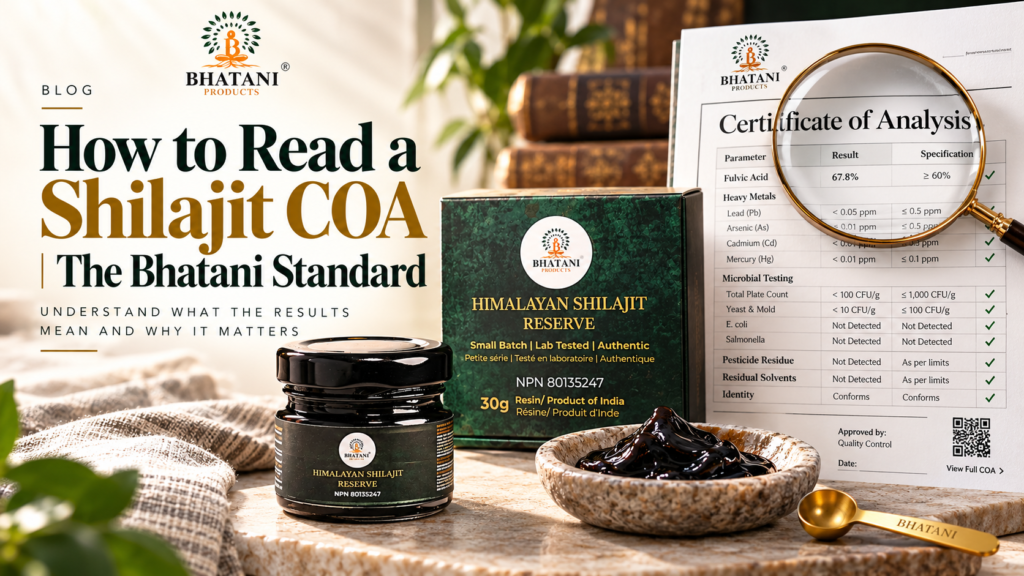
A Shilajit lab report can tell you more than a product photograph or an impressive marketing claim. But what do the numbers actually mean? This guide explains how to read a Shilajit Certificate of Analysis (COA), understand testing terminology, and ask better questions before buying Shilajit in Canada.
“The strongest brands don’t ask you to trust them blindly. They give you reasons to.”
What Is a Shilajit Certificate of Analysis?
A Shilajit Certificate of Analysis (COA) is a quality document that records information about a material or product and the results of specified tests. Depending on who issued it, a COA may relate to a raw ingredient, a processed material, or a finished production batch.
It may include the product identity, batch number, testing date, laboratory information, test methods, results, and acceptance specifications.
A COA is useful because it provides information that can be examined rather than simply accepted as advertising. However, a COA does not automatically establish that every possible contaminant was tested, that the finished product matches the tested sample, or that a product is suitable for every individual.
Quick Answer: How Do You Read a Shilajit COA?
Start by checking the product name, sample description, batch number, testing laboratory, and report date. Next, examine the tests performed, the reported results, their units, and the applicable specifications. Finally, confirm that the report relates to the Shilajit product or batch you are considering.
Why Should Shilajit Buyers Check Lab Reports?
Shilajit is a naturally occurring material associated with mountainous regions. Its composition can vary with its source and processing. That makes appropriate quality controls and testing particularly relevant.
When reviewing a Shilajit product, it is reasonable to ask whether the company has documentation covering identity, relevant contaminants, and other established quality specifications.
A report can help answer those questions, but its usefulness depends on what was tested, how the results were obtained, and whether the tested sample corresponds to the product being sold.
How to Read a Shilajit COA: 9 Things to Check
Laboratory reports can look intimidating. Fortunately, you do not need to understand every analytical technique to begin evaluating the document.
Product Identification
Confirm whether the report describes Shilajit resin, a raw ingredient, an extract, or a finished product. A report for a raw ingredient should not automatically be treated as a report for the finished jar.
Batch or Lot Number
Look for a batch or lot identifier. Ask the company how that identifier relates to the batch number on your product packaging.
Testing Date
Review the sample receipt, testing, and report dates where available. Dates provide context, although an older report is not necessarily invalid solely because of its age.
Laboratory Information
Identify the laboratory that performed the testing. Where accreditation is claimed, check whether the accreditation covers the relevant test methods.
Test Methods
A report may identify the analytical methods used. These help explain how a result was obtained and whether the method is appropriate for the sample and substance being tested.
Heavy Metals
Look for relevant testing information for contaminants such as lead, cadmium, arsenic, and mercury, including the reported values, units, and applicable limits.
Microbiological Tests
Review whether appropriate microbiological tests were performed and how the reported results compare with the applicable specifications.
Results and Specifications
Read the numerical result alongside its acceptance criterion. A number without its units, method, and relevant specification may be difficult to interpret.
Report Authenticity
Check for a report identifier and other verification details. If something appears inconsistent, ask the company or issuing laboratory for clarification.
How to Understand Heavy Metal Results in Shilajit
Heavy metal testing is one of the important subjects to understand when reading a Shilajit lab report.
Reports may include results for lead, arsenic, cadmium, and mercury. These substances require appropriate evaluation because exposure and health risks depend on factors such as the chemical form, concentration, amount consumed, and duration of exposure.
A result should not be interpreted in isolation. You need to understand the measurement units, the relevant acceptance criteria, and the product’s intended use.
What Do ppm and mg/kg Mean?
Laboratory results are sometimes expressed in parts per million (ppm) or milligrams per kilogram (mg/kg).
For mass-based measurements, 1 ppm is equivalent to 1 mg/kg. This tells you the concentration of a substance in the tested material. It does not, by itself, tell you the amount a person would consume.
To evaluate exposure, concentration must be considered alongside the amount of product used and the relevant regulatory or toxicological criteria.
Example: How to Read a Laboratory Results Table
The following table is an illustrative example only. It is not a Bhatani Products laboratory report, and the numbers below are not real test results or regulatory limits.
Lead
Reported result: 0.12 mg/kg
Illustrative specification: Not more than 0.50 mg/kg
Interpretation: The result is below the example specification. Whether that specification is appropriate must be established separately.
Cadmium
Reported result: ND
Detection limit: 0.02 mg/kg
Interpretation: Cadmium was not detected at or above the stated detection limit. This does not prove absolute absence.
Important: The example specifications are invented solely to demonstrate how to read a table. Do not use them as purchasing thresholds or Canadian compliance standards.
What Do ND, LOD, and LOQ Mean on a COA?
These abbreviations appear frequently in analytical testing reports. Understanding them helps prevent one of the most common misunderstandings about laboratory results.
Not Detected
The laboratory did not detect the substance according to the method and reporting criteria used. ND does not necessarily mean the substance is completely absent.
Limit of Detection
The lowest level at which a method can reliably detect the presence of an analyte under defined conditions.
Limit of Quantification
The lowest level at which a method can quantify an analyte with acceptable analytical performance under defined conditions.
For example, a result reported as ND with a detection limit of 0.02 mg/kg means the substance was not detected at that level using the specified method. It does not justify saying the product contains zero of that substance.
What Does Microbiological Testing Tell You?
Microbiological testing evaluates specified microorganisms or microbial indicators in a sample. Depending on the product and applicable requirements, a laboratory report may address total microbial counts, yeast and mould, or particular organisms of concern.
Different tests answer different questions. A satisfactory result for one microorganism does not automatically establish that all possible microbiological risks have been evaluated.
The relevant question is whether appropriate tests were performed and whether their results meet the established specifications for that product.
How Can You Tell Whether a Shilajit COA Is Genuine?
A professional-looking PDF is not proof that a laboratory report is authentic. Consumers should look beyond the document’s appearance.
COA Verification Checklist
- Does the report identify the tested material clearly?
- Is there a report number or another traceable identifier?
- Can you identify the issuing laboratory?
- Are the testing dates and sample details understandable?
- Does the report distinguish results from acceptance specifications?
- Does the company explain how the tested sample relates to the product being sold?
- Can the laboratory or manufacturer clarify an apparent inconsistency?
Some laboratories provide verification services or report-authentication systems. Others may have restrictions on disclosing customer information. If independent verification is not available, ask the brand for a clear explanation of its documentation process.
Why Laboratory Accreditation Matters
You may see a laboratory describe itself as accredited to ISO/IEC 17025. This is an international standard relating to the competence, impartiality, and consistent operation of testing and calibration laboratories.
Accreditation can provide additional context, but it is important to check the laboratory’s scope of accreditation. Not every test performed by an accredited laboratory is necessarily included within its accredited scope.
Accreditation also does not mean that every product tested by the laboratory is automatically approved, safe, or compliant.
COA vs. Health Canada NPN: What’s the Difference?
Canadian buyers should understand that a Certificate of Analysis and a Natural Product Number serve different purposes.
Certificate of Analysis
Reports specified testing information about an identified sample or batch. Its value depends on the sample, methods, results, and relevance to the finished product.
Natural Product Number
An eight-digit number identifying a natural health product authorized by Health Canada under Canada’s natural health product regulatory framework.
A COA does not replace an NPN, and an NPN does not replace appropriate manufacturing controls and laboratory testing.
Bhatani Himalayan Shilajit Reserve 30g carries Health Canada NPN 80135247. Customers can check product authorization information using the official Licensed Natural Health Products Database.
For additional information about Canadian quality expectations, see Health Canada’s Quality of Natural Health Products Guide and Good Manufacturing Practices guidance.
How Bhatani Approaches Quality Documentation
At Bhatani Products, our approach begins with a simple principle: customers deserve understandable information about what they purchase.
Our Himalayan Shilajit Reserve is a resin-format product sourced from India and packed in Canada. We emphasize batch traceability, third-party laboratory testing, clear product labelling, and customer education.
We believe that quality documentation should support informed questions rather than serve as a collection of impressive-looking numbers.
You can explore our available quality information and documentation on the Bhatani Certificates page. When reviewing any document, check its sample identification and applicability to the product or batch you have purchased.
The Bhatani Standard: Know Your Jar
- NPN: Check the Canadian product authorization number.
- Batch: Identify the lot or batch information on your jar.
- Expiry: Review the labelled expiry date.
- Origin: Product of India.
- Packing: Packed in Canada.
- Documentation: Review available certificates and ask questions when clarification is needed.
Three Mistakes to Avoid When Comparing Shilajit Lab Reports
1. Assuming “Lab Tested” Explains Everything
The phrase does not tell you which tests were performed, which sample was tested, or whether the results met appropriate specifications. Ask for context.
2. Treating “Not Detected” as Absolute Zero
Detection depends on the analytical method and its limits. A properly interpreted ND result is more informative than a blanket claim of zero contaminants.
3. Comparing Numbers Without Units or Specifications
Results reported in different units, for different sample types, or using different analytical methods may not be directly comparable. A lower number is not automatically a more meaningful result without context.
Questions to Ask Before Buying Shilajit in Canada
You do not need to become a laboratory scientist to make a more informed purchasing decision. Start with a few practical questions.
- Is the product authorized as a natural health product in Canada?
- Can I verify its NPN through Health Canada’s database?
- Does the company provide understandable information about laboratory testing?
- Does the testing relate to the material or finished product I am purchasing?
- Can I identify the batch number on the product packaging?
- Will the company explain its quality documentation if I have questions?
For another practical purchasing guide, read Real or Fake Shilajit? How to Tell in Canada.
Know More About What Goes Into Your Jar.
Discover Bhatani Himalayan Shilajit Reserve 30g — resin-format Shilajit with Health Canada NPN 80135247, batch traceability, and a commitment to transparent product information.
EXPLORE BHATANI SHILAJITFrequently Asked Questions
What is a Shilajit COA?
A Shilajit Certificate of Analysis is a document containing specified quality-testing information for an identified material or product sample. It may include test results, methods, dates, and acceptance specifications.
What heavy metals should I look for on a Shilajit lab report?
Commonly evaluated contaminants include lead, arsenic, cadmium, and mercury. The appropriate testing program and acceptance criteria depend on the product, its use, and applicable requirements.
Does ND mean a Shilajit product contains no heavy metals?
No. ND generally means the substance was not detected according to the method and reporting criteria used. It does not necessarily establish complete absence.
Can I verify a Shilajit COA?
You can examine the report identifier, laboratory information, dates, sample description, and batch details. Some laboratories offer independent report verification. You can also ask the manufacturer to explain how the report relates to its product.
Is a Shilajit COA the same as a Health Canada NPN?
No. A COA provides specified analytical information about a sample or batch. An NPN identifies a natural health product authorized by Health Canada.
Where can I check Bhatani’s Shilajit NPN?
Bhatani Himalayan Shilajit Reserve carries NPN 80135247. You can search this number in Health Canada’s Licensed Natural Health Products Database.
Does a COA guarantee that Shilajit is safe?
No. A COA documents specified testing information and does not guarantee universal safety, suitability, or freedom from all possible risks. Consumers should also consider regulatory authorization, product directions, cautions, and individual circumstances.
A Final Thought: Transparency Should Be Understandable
The purpose of a laboratory report is not to overwhelm customers with scientific terminology. Its value lies in the information it provides and the questions it helps answer.
Whether you choose Bhatani Products or another company, take time to understand what a report actually says. Look at the sample, the tests, the results, and the specifications. Ask questions when something is unclear.
At Bhatani, we believe informed customers help build a better wellness industry. Education comes first. Trust follows from the details.
Article By: Neeraj Bhatnagar
Founder, Bhatani Products
“I believe a customer should never have to choose between understanding a product and trusting the company behind it. Good questions deserve clear answers. That belief is part of why we built Bhatani.”
Heritage Refined.
Disclaimer: This article is for educational and informational purposes only. It does not constitute medical, toxicological, regulatory, or laboratory interpretation advice. Example values are fictional and must not be used as product specifications or safety thresholds. Always follow product label directions and cautions. Consult a qualified healthcare professional if you have questions about whether a natural health product is appropriate for you.