
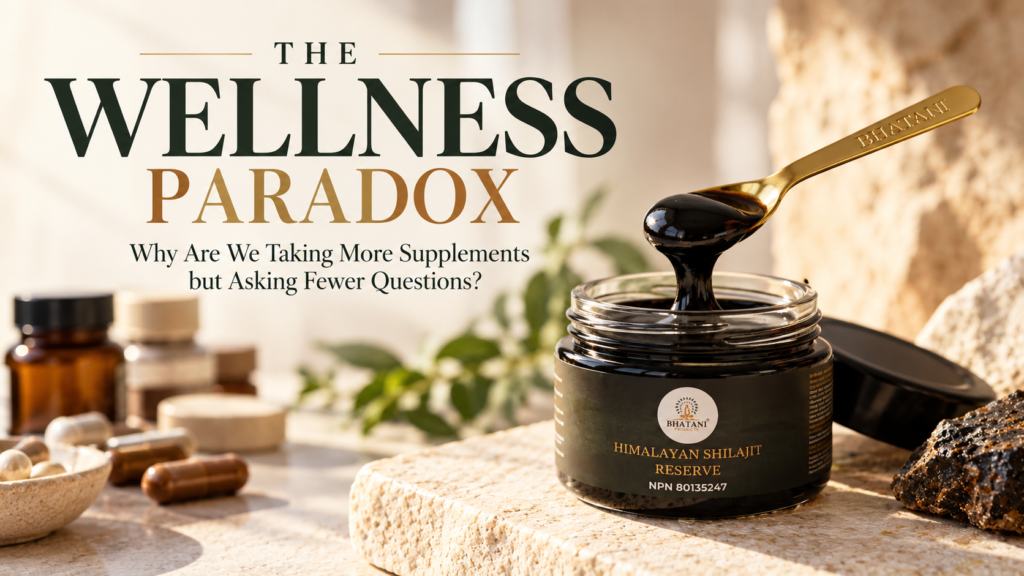
Are wellness supplements worth it? For Canadians, the answer depends on what you need, the evidence supporting a product, its quality, its cost and whether it is appropriate for you. Some supplements can be useful in specific circumstances. Others may add expense and complexity without providing a meaningful benefit. Understanding the difference is the first step toward making a more informed decision.
We count our steps, monitor our sleep, track our hydration and pay attention to what we eat. Yet every week, another wellness product appears promising to transform our routines.
From vitamins and minerals to botanical extracts and Shilajit resin, the supplement market offers an enormous range of choices. Attractive packaging, influencer recommendations and scientific-sounding claims can make it difficult to distinguish useful information from marketing.
This creates an interesting wellness paradox: Are we becoming better informed about our wellbeing, or simply becoming better at consuming?
At Bhatani Products , we believe a thoughtful wellness routine should begin with understanding, not pressure to purchase.
More products do not automatically create better wellbeing. Better questions can lead to better decisions.
1. Are Wellness Supplements Worth It for Canadians?
There is no universal yes-or-no answer. The value of a supplement depends on the reason for using it and the evidence supporting that particular use.
Certain supplements can help address specific nutritional needs. For example, vitamin B12 supplementation may be important for people who do not obtain sufficient B12 through their diets. Vitamin D supplementation may also be appropriate in certain circumstances.
Other products are marketed for broad goals such as vitality, balance or general wellness, even when evidence for those promises is limited.
The important distinction is between a supplement that addresses an identifiable need and one purchased mainly because it is popular.
When might a supplement be worthwhile?
A supplement may be worth considering when a qualified healthcare professional identifies a nutritional deficiency, an increased nutritional requirement or another evidence-supported reason.
Individual dietary patterns, age, health conditions and medication use may influence those decisions.
When might a supplement be unnecessary?
If you do not have a clear reason to use a product, or the evidence supporting its intended purpose is weak, the expected benefit may not justify its cost or risks.
Supplements should not replace nutritious food, adequate sleep, regular movement or appropriate medical care.
A Specific Need
A supplement addresses an identifiable nutritional or health-related need supported by appropriate evidence and guidance.
A General Promise
A product is promoted for broad wellness goals without convincing evidence for the specific benefit being advertised.
An Informed Choice
You understand the purpose, evidence, risks, price and recommended conditions of use before purchasing.
2. How Can You Tell Supplement Science From Marketing?
Wellness advertising often highlights what a product might do. Responsible education should also explain what is known, what remains uncertain and who may need to avoid a product.
Not all scientific evidence carries the same weight. Laboratory experiments, animal studies and human clinical trials answer different questions.
A compound showing interesting activity in a laboratory does not automatically establish that consuming a supplement will produce the same effect in humans.
What should you look for in research?
Consider whether the evidence involves human participants, whether the study examined the same preparation being sold and whether the results have been replicated.
Pay attention to the quantity used, the duration of the study and the characteristics of its participants.
A study involving a concentrated botanical extract may not apply to a different preparation of the same ingredient.
Are customer testimonials enough?
Customer experiences can describe personal impressions, but they cannot establish that a product caused a particular outcome.
Changes in sleep, energy or general wellbeing can have many explanations, including lifestyle, expectations and individual variation.
Testimonials should therefore be considered alongside stronger evidence rather than treated as clinical proof.
A beautiful jar may earn attention. Clear information helps earn confidence.
3. Does a Health Canada NPN Make a Supplement Worth Buying?
An NPN is an important regulatory identifier, but it is not a personal guarantee of benefit.
In Canada, licensed natural health products generally display an eight-digit Natural Product Number (NPN).
Health Canada authorizes these products after assessing submitted information concerning safety, effectiveness and quality under their recommended conditions of use.
An NPN does not mean the product is risk-free, suitable for everyone or effective for purposes beyond its authorized uses.
How can Canadians verify an NPN?
Use the Health Canada Licensed Natural Health Products Database .
Search the product’s NPN and compare the official record with the information on the label.
Review the medicinal ingredients, recommended uses, directions, warnings and contraindications.
For a detailed explanation of product authorization, read our guide to Shilajit safety and legality in Canada .
4. Are Expensive Wellness Supplements Better?
A higher price does not automatically mean a product is more effective or safer.
Pricing may reflect ingredient sourcing, manufacturing, testing, packaging, distribution, marketing or brand positioning.
Some of these factors may represent meaningful quality investments. Others may have little relationship to the benefit a customer receives.
How should you evaluate the price?
Compare the price against the actual product quantity, recommended use, quality information and evidence supporting its intended purpose.
A low-priced supplement is not automatically poor quality. Similarly, an expensive supplement is not automatically superior.
The most important question is whether the product offers something relevant to your needs.
What is the real monthly cost?
A useful way to compare products is to calculate the cost of following their recommended use over a month.
For example, a product priced at $60 that lasts 30 days costs approximately $2 per day.
This calculation does not establish whether the product works. It simply makes the financial commitment easier to understand.
Cost Per Day
Divide the purchase price by the number of days supplied at the labelled recommended use.
What Is Verifiable?
Examine licensing, ingredients, batch information and relevant testing documentation.
Is There a Reason?
Decide whether the intended purpose and supporting evidence justify the expense for you.
5. What Should Canadians Check Before Buying Supplements?
Before buying a wellness supplement, it helps to use the same questions every time.
This approach reduces the influence of marketing and makes different products easier to compare.
The Bhatani Seven-Question Buying Checklist
- 1. Do I need it? Identify a specific reason for considering the product.
- 2. Is there evidence? Look for appropriate research supporting the intended use.
- 3. Is it authorized? For Canadian natural health products, check the NPN and verify it where applicable.
- 4. What is inside? Read the medicinal and non-medicinal ingredients.
- 5. What are the risks? Review cautions, contraindications and possible medication interactions.
- 6. What quality information exists? Examine sourcing, batch identification and relevant testing documentation.
- 7. Is the price justified? Compare the cost with your needs, the available evidence and your budget.
6. What About Shilajit, Saffron and Ashwagandha?
Botanical and naturally derived ingredients are increasingly discussed in wellness communities.
Shilajit, saffron and ashwagandha each have distinct characteristics, histories and research profiles.
However, their natural origins do not establish that every preparation is effective or appropriate for every person.
Shilajit Resin
Shilajit is a complex naturally occurring substance. Its composition can vary according to sourcing and processing.
Researchers have investigated particular Shilajit preparations, but human clinical evidence remains limited for many widely advertised wellness outcomes.
Product licensing, purification, relevant contaminant testing and label instructions deserve attention.
For more information, read Before You Buy Shilajit: Know Your Jar .
Kashmiri Saffron
Saffron is valued for its colour, aroma and culinary heritage.
Researchers have also investigated certain saffron extracts for health-related outcomes.
Findings involving concentrated extracts should not automatically be applied to ordinary saffron threads used in cooking.
For many people, saffron’s most immediate value is culinary rather than medicinal.
Ashwagandha
Ashwagandha is a botanical ingredient used in various supplement preparations.
Research has examined specific formulations for selected health-related outcomes, but the findings do not apply equally to every product or individual.
Ashwagandha may cause adverse reactions or interact with medications. Certain individuals, including those who are pregnant, should avoid unsupervised use.
The National Center for Complementary and Integrative Health provides additional information about ashwagandha research and safety considerations.
An ingredient’s history may inspire curiosity. Its evidence, quality and suitability should guide the decision.
7. Can a Simpler Wellness Routine Be More Valuable?
Sometimes the most useful wellness decision is not buying another product.
Consistent sleep, balanced meals, regular movement, hydration and appropriate healthcare remain important foundations of wellbeing.
Supplements may have a role in particular circumstances, but they do not replace these foundations.
How do you build a thoughtful routine?
Begin with the habits you can realistically maintain.
Choose manageable goals rather than trying to transform every aspect of your lifestyle at once.
If a supplement is appropriate for you, follow its label and evaluate its place in your routine with realistic expectations.
Avoid assuming that taking multiple supplements together will necessarily produce better results.
More ingredients can also mean more opportunities for interactions and unwanted effects.
A Simple Decision: Buy, Research or Reconsider?
If you are still wondering whether wellness supplements are worth it, consider these three possible next steps.
A Clear Purpose
You have an identifiable need, relevant evidence, appropriate professional guidance where needed and a suitable product.
Unanswered Questions
You are unsure about the ingredients, licensing, evidence, interactions or quality information.
Marketing Over Evidence
The main reason for purchasing is a trend, exaggerated promise or fear of missing out.
How Does Bhatani Approach Wellness Product Quality?
At Bhatani Products, we believe transparency should be part of the purchasing experience.
Our Himalayan Shilajit Resin is a 30 g product sourced from India and packed in Canada.
The product carries Health Canada NPN 80135247, with batch and expiry information displayed on its label.
Our approach emphasizes batch traceability, third-party testing and access to relevant quality documentation.
Customers can explore our Certificates and Quality Standards page for more information.
These details support informed evaluation. They are not promises of particular medical or wellness outcomes.
We believe a responsible brand should explain what it knows, acknowledge limitations and respect the customer’s ability to decide.
Choose With Knowledge. Begin With Intention.
Explore Bhatani Himalayan Shilajit Resin and learn about our approach to quality, transparency and thoughtful everyday routines.
EXPLORE BHATANI COLLECTIONA Message From the Founder
When I started building Bhatani Products, I wanted the brand to represent something beyond a collection of products.
I wanted it to reflect respect for heritage, thoughtful choices and a commitment to treating customers as informed individuals.
Trends change, and new ingredients attract attention, but those principles should remain.
I want customers to read the label, ask questions, explore the available information and make decisions grounded in understanding rather than pressure.
We do not need to promise everything. We need to be responsible for what we promise.
Neeraj Bhatnagar
Founder, Bhatani Products — Heritage Refined
Frequently Asked Questions About Wellness Supplements
Are wellness supplements worth it?
They may be worthwhile when they address a specific need supported by appropriate evidence. Their value depends on the product, individual circumstances, potential risks and cost.
Do healthy adults need supplements?
Not necessarily. Some people can meet their nutritional needs through food, while others may benefit from particular supplements because of dietary patterns, health conditions or other circumstances.
Are expensive supplements better?
Not automatically. Price alone does not establish safety, effectiveness or product quality.
How do I know if a supplement works?
Evaluate research relevant to the specific ingredient, formulation and intended use. Discuss measurable goals with a qualified healthcare professional when appropriate.
What does an NPN mean in Canada?
An NPN identifies a natural health product authorized by Health Canada under specified conditions of use. It does not guarantee the product is suitable for everyone.
Does third-party testing prove a supplement is effective?
No. Depending on the testing performed, it may provide information about identity, composition or specified contaminants. It does not independently prove clinical effectiveness.
Are natural supplements always safe?
No. Natural ingredients may cause side effects or interact with medications. Follow product warnings and seek professional guidance when appropriate.
Should I take several supplements together?
Combining products can increase the possibility of overlapping ingredients, excessive intake or interactions. Review combinations with a qualified healthcare professional when appropriate.
Final Thoughts: Are Wellness Supplements Worth It?
So, are wellness supplements worth it? Sometimes they are. Sometimes they are not.
Their value depends on whether they address a genuine need, whether appropriate evidence supports their intended use, whether the product is suitable for you and whether the expense is justified.
The best wellness decision is not always the one that adds something new.
Sometimes it is the decision to ask another question, review a label, consult a professional or strengthen an existing healthy habit.
At Bhatani, we believe those thoughtful choices deserve as much attention as the products themselves.
Heritage Refined.
Official Sources and Further Reading
- Health Canada — Licensed Natural Health Products Database
- Health Canada — Natural and Non-prescription Health Products
- National Institutes of Health — Dietary Supplements: What You Need to Know
- NCCIH — Ashwagandha: Usefulness and Safety
Educational Disclaimer: This article provides general educational information and is not medical advice. It does not establish therapeutic benefits for any Bhatani Products item. Natural health products may cause adverse effects, interact with medications or be unsuitable for certain individuals. Follow the directions, contraindications and warnings on the current product label. Consult a qualified healthcare professional when appropriate. Do not replace prescribed treatment with supplements without professional guidance.