What Makes Kashmiri Saffron and Ashwagandha Different? How can you tell if saffron is real? And what is the difference between ashwagandha root powder and extract? These are important questions for Canadians exploring two remarkable botanicals with very different histories.
One begins as delicate crimson threads carefully collected from a flower. The other comes from the roots of a plant that has been used for generations in South Asia. Both have attracted modern interest, yet their origins, preparation methods, and everyday uses are distinctly different.
Welcome to The Bhatani Heritage — an exploration of Kashmiri saffron, ashwagandha, and the thoughtful details that help consumers understand what they are choosing.
At Bhatani Products, our philosophy is simple: heritage deserves to be understood, quality deserves to be questioned, and trust should be earned through transparency.
What Does Heritage Refined Mean?
Heritage is more than a place of origin. It includes the people, knowledge, and practices associated with an ingredient over time.
But heritage alone cannot establish authenticity or quality. Modern consumers deserve to understand the ingredient itself, how it is prepared, and what information is available about the finished product.
Know Where It Begins
Understand the plant, growing region, and traditional uses associated with each ingredient.
Look Beyond the Label
Explore ingredient identity, preparation methods, and the difference between appearance and verified quality.
Choose With Understanding
Ask meaningful questions about ingredients, product information, and responsible sourcing.
“The beauty of heritage is not simply knowing where something comes from. It is understanding why its story matters.”
What Makes Kashmiri Saffron Special?
Saffron comes from the dried stigmas of the Crocus sativus flower. Each flower produces only three stigmas, which are carefully collected and dried to create the spice recognized for its distinctive colour, aroma, and flavour.
Kashmir is one of the world’s historically recognized saffron-growing regions. The area around Pampore, in particular, is associated with longstanding saffron cultivation.
Kashmiri saffron is valued for its culinary character and regional identity. However, the quality of any individual saffron product still depends on factors such as authenticity, harvesting, drying, storage, and handling.
Why Is Kashmiri Saffron So Expensive?
Saffron is one of the world’s most labour-intensive spices. Its flowers bloom during a limited seasonal window, and each produces only a small amount of usable material.
The stigmas must be separated and dried with care. Producing even a modest quantity of finished saffron requires a large number of flowers.
This labour-intensive process contributes to saffron’s price. Growing conditions, supply, origin, and quality also influence its market value.
For Canadian buyers, an important lesson is that price alone does not prove authenticity. A high price may reflect genuine production costs, but it is not a substitute for reliable product information.
How Can You Tell If Saffron Is Real?
Genuine saffron threads have a characteristic appearance, aroma, and colouring behaviour. However, counterfeit and adulterated products can sometimes imitate these features.
Begin by examining the product description, declared origin, packaging, and seller transparency.
Examine the Threads
Whole saffron threads can be examined more easily than unidentified powders, although visual inspection alone cannot prove purity.
Recognize Its Character
Genuine saffron has a distinctive aroma influenced by its natural volatile compounds and processing conditions.
Look for Evidence
Product origin information and appropriate laboratory analysis provide stronger evidence than home authenticity tests.
Some online guides recommend placing saffron threads in water to judge how quickly colour appears. Such demonstrations can be interesting, but they cannot conclusively establish authenticity or detect every type of adulteration.
A better buying decision combines product knowledge with trustworthy documentation and transparent seller information.
How Do Canadians Use Saffron in Everyday Cooking?
Saffron has a place in cuisines across many regions, including South Asia, the Middle East, and Europe. Its distinctive character also makes it a wonderful ingredient for Canadians who enjoy experimenting with new flavours.
It can be used in rice dishes, desserts, warm milk, and selected tea preparations. A small culinary quantity can contribute colour, aroma, and flavour.
How Do You Make Saffron Milk?
Saffron milk is a simple way to explore the spice’s culinary character.
- Warm one cup of milk or a suitable milk alternative.
- Place a few saffron threads in a small amount of warm milk.
- Allow the threads to steep for approximately 10 to 15 minutes.
- Combine the infusion with the remaining warm milk.
- Adjust sweetness according to personal preference, if desired.
The result is a gently aromatic drink with saffron’s characteristic colour and flavour. This is a culinary preparation, not a medical treatment or supplement dosage recommendation.
Can You Add Saffron to Rice Pudding?
Yes. Saffron complements rice-based desserts beautifully. It can be steeped in a little warm milk and added during cooking to distribute its colour and aroma.
For those who grew up enjoying kheer or firni, saffron can carry a familiar connection to family kitchens and shared meals. For Canadians discovering these dishes, it offers an inviting introduction to a new culinary tradition.
What Does Saffron Taste Like?
Saffron has a distinctive flavour often described as earthy, floral, and subtly bitter. Its aroma and flavour depend on the quantity used, the recipe, and the quality of the spice.
Using too much can overpower a dish, so recipes generally begin with a small amount.
How Should Saffron Be Stored?
Keep saffron in a tightly sealed container away from moisture, direct sunlight, and excessive heat.
Avoid exposing the threads repeatedly to steam or humidity. Thoughtful storage helps preserve the sensory qualities that make saffron special.
Five Things to Check Before Buying Saffron in Canada
- Botanical identity: Look for saffron identified as Crocus sativus.
- Declared origin: Understand where the seller says the saffron was produced.
- Product form: Know whether you are purchasing whole threads or powder.
- Storage and packaging: Look for suitable protection from moisture and light.
- Seller transparency: Consider whether the brand provides clear information about the ingredient.
What Is Ashwagandha Root?
Ashwagandha is the common name for Withania somnifera, a plant associated with longstanding botanical traditions in South Asia.
Its roots are used in several preparations, including dried root powders and extracts. Modern products may contain these ingredients in capsules or other formats.
Ashwagandha has also become a subject of scientific research, particularly in studies examining specific preparations and their effects in humans.
Understanding the ingredient begins with an important distinction: the name “Ashwagandha” does not tell you everything about the product inside a package.
What Is the Difference Between Ashwagandha Root Powder and Extract?
Ashwagandha root powder is generally made by drying and grinding the root.
An Ashwagandha extract undergoes additional processing intended to separate or concentrate selected constituents.
Extracts can differ significantly depending on the extraction method, plant material, and standardization process.
Ground Root Material
Made from dried botanical material. Composition depends on the plant source and processing.
Extracted Preparation
Produced through an extraction process. Concentration and composition vary between preparations.
Read the Label
Examine the ingredient description, quantity, directions, and relevant precautions.
What Are Withanolides in Ashwagandha?
Withanolides are a group of naturally occurring steroidal lactones found in plants such as Withania somnifera.
They are frequently discussed in Ashwagandha research and may appear in product standardization information.
However, a higher stated withanolide percentage does not automatically mean that a product is better, safer, or more effective.
The specific preparation, analytical method, dosage, and available clinical evidence all matter.
What Does Scientific Research Say About Ashwagandha?
Researchers have investigated selected Ashwagandha preparations in clinical studies involving stress, sleep, and other outcomes.
Some findings have been promising, but the evidence has important limitations, including differences in study design, sample size, duration, and the formulations tested.
Research involving one preparation cannot automatically establish the effects of another product.
Readers who want an independent overview can explore the National Center for Complementary and Integrative Health’s Ashwagandha research summary.
What Should Canadians Know Before Buying Ashwagandha?
Not all Ashwagandha products are equivalent. Differences in root material, extraction, formulation, and labelling can affect what consumers are purchasing.
Review the product’s ingredient description, directions, warnings, and any available quality documentation.
Ashwagandha may cause adverse effects or interact with medications. Particular caution is important during pregnancy or breastfeeding and for people with certain thyroid, autoimmune, or liver-related conditions.
Anyone taking medication or managing a medical condition should consult a qualified healthcare professional before using an Ashwagandha natural health product.
Saffron vs Ashwagandha: What Is the Difference?
Although both ingredients come from plants, they have different botanical identities and common uses.
Crocus sativus
Dried flower stigmas valued primarily as a culinary spice for their colour, aroma, and flavour.
Withania somnifera
A botanical root used in powders and extracts, including natural health product formulations.
Not Interchangeable
Their composition, preparation, intended use, and research histories are different.
Saffron sold as an ordinary culinary spice is not necessarily regulated in the same way as a concentrated natural health product. Consumers should consider the intended use and product classification.
Where Does Shilajit Fit Into the Bhatani Heritage?
Alongside Kashmiri saffron and Ashwagandha, Bhatani also offers Himalayan Shilajit Resin.
Shilajit is a naturally occurring complex resin-like substance rather than a plant root or flower stigma. It has a different composition and requires its own approach to sourcing, processing, and quality evaluation.
Bhatani Himalayan Shilajit Resin carries Health Canada NPN 80135247. Information about Bhatani’s quality approach is available on our Certificates and Quality Standards page.
These three ingredients represent different traditions and product categories. They should not be considered interchangeable or assumed to produce additional benefits simply because they are offered together.
Discover the Bhatani Heritage Bundle
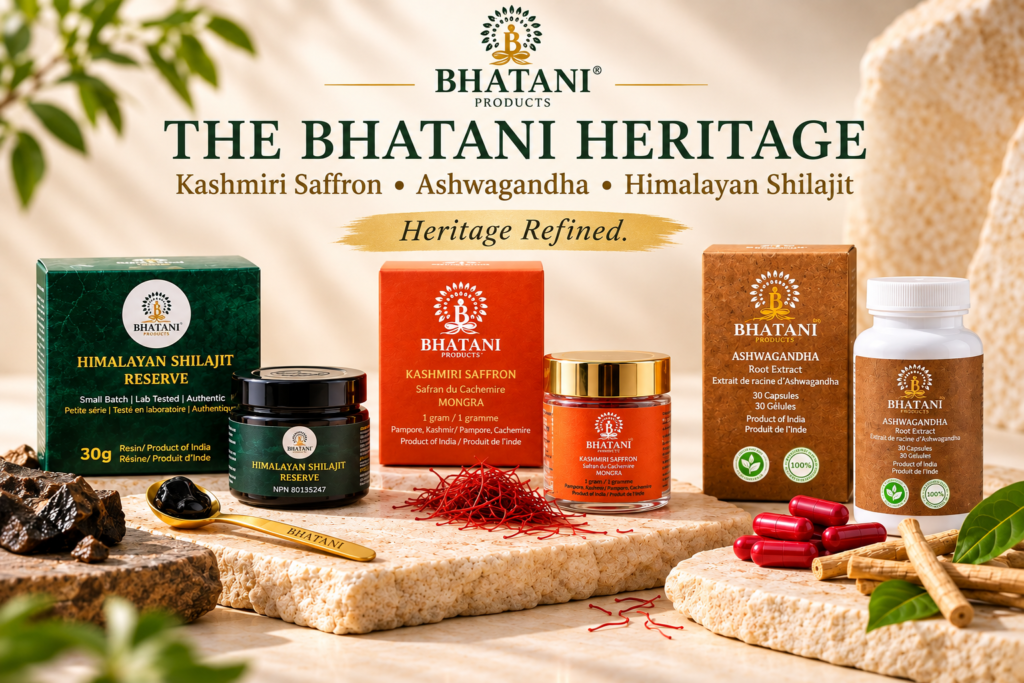
The Bhatani Heritage Bundle brings together three distinct products: Kashmiri Saffron, Ashwagandha capsules, and Himalayan Shilajit Resin.
Rather than presenting them as a single combined formula, the collection allows customers to explore each product individually, with attention to its own ingredients, directions, and precautions.
Three Ingredients. One Bhatani Collection.
Discover Kashmiri Saffron, Ashwagandha Root Extract, and Himalayan Shilajit Resin in the Bhatani Heritage Bundle. Distinctive ingredients brought together with a focus on quality, transparency, and thoughtful presentation.
EXPLORE THE HERITAGE BUNDLEFrequently Asked Questions
Why is Kashmiri saffron expensive in Canada?
Saffron production is labour-intensive, each flower yields only three stigmas, and harvesting is seasonal. Origin, supply, and product quality can also affect price.
How can you identify genuine Kashmiri saffron?
Check the declared origin, ingredient identity, appearance, packaging, and available quality documentation. Home tests alone cannot conclusively prove authenticity.
Can saffron be used in milk or tea?
Yes. Saffron is commonly steeped in warm liquid before being added to milk, selected teas, rice dishes, and desserts for culinary flavour, colour, and aroma.
How should saffron be stored?
Store saffron in a tightly sealed container away from moisture, direct sunlight, and excessive heat to help preserve its sensory qualities.
What is Ashwagandha root extract?
Ashwagandha root extract is produced by processing root material to obtain selected constituents. Extracts can vary in composition and concentration.
Is Ashwagandha root powder the same as extract?
No. Root powder is ground botanical material, while an extract undergoes additional processing. The two should not automatically be treated as equivalent.
What are withanolides?
Withanolides are naturally occurring compounds found in Ashwagandha and related plants. Their presence or stated percentage alone does not establish product effectiveness or safety.
Can Ashwagandha and saffron be used together?
The appropriateness of combining products depends on their formulations, doses, individual health circumstances, and possible interactions. Review the labels and consult a healthcare professional before combining natural health products.
What is included in the Bhatani Heritage Bundle?
The collection includes Kashmiri Saffron, Ashwagandha capsules, and Himalayan Shilajit Resin. Each is a separate product with its own label information.
Heritage Refined: Understanding What We Choose
Kashmiri saffron and Ashwagandha are different ingredients with their own origins, characteristics, and histories.
Saffron invites exploration through cooking, aroma, and the care involved in its cultivation. Ashwagandha invites questions about botanical identity, root preparations, and the distinction between traditional use and modern research.
Both deserve more than exaggerated promises or generic descriptions.
At Bhatani, we believe that learning about an ingredient is part of appreciating its heritage. From the questions we ask to the products we choose, informed decisions begin with understanding.
“Heritage is what we inherit. Understanding is how we honour it.”
Further Reading
For readers interested in exploring the ingredients beyond this guide, these independent educational resources offer additional scientific context:
- Scientific review of Crocus species and their constituents — botanical and research background relevant to saffron.
- Ashwagandha: Usefulness and Safety — an independent overview of the evidence and precautions.
Educational Disclaimer: This article provides general information about ingredients, culinary uses, and published research. It is not medical advice and does not establish authorized health claims for Bhatani products. Findings from studies of specific preparations should not be generalized to other products. Natural health products may have contraindications, adverse effects, or medication interactions. Always follow the directions and warnings on the applicable product label and consult a qualified healthcare professional when appropriate. Culinary saffron use should not be confused with concentrated supplement use.