
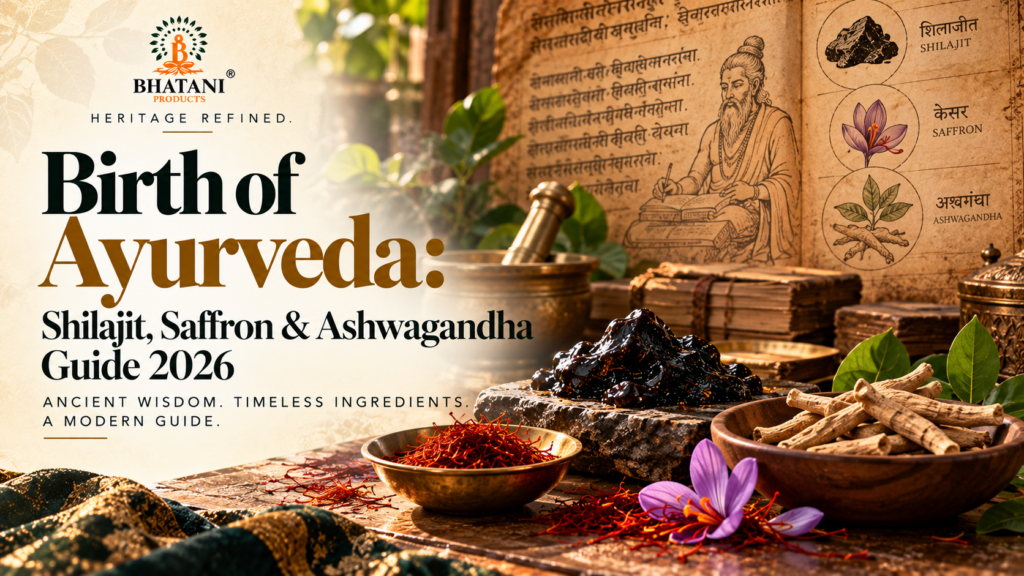
Long before modern wellness became an industry, ancient Indian scholars were asking a question that remains relevant today: What does it mean to live well? Their observations helped shape Ayurveda, a traditional system of knowledge connecting daily habits, food, nature and the rhythms of life.
The birth of Ayurveda is part of a remarkable history spanning thousands of years. Within that history, three ingredients have earned enduring cultural recognition: Shilajit, saffron and ashwagandha. Each has a different origin, identity and place in traditional practices.
But understanding Ayurveda means looking beyond popular ingredient claims. It means exploring the ancient texts, separating historical beliefs from modern research, and learning how to make informed choices in today’s Canadian wellness market.
This 2026 guide explores where Ayurveda began, why these three ingredients became significant, and how the idea of a thoughtful daily ritual continues to resonate.
When and Where Was Ayurveda Born?
Ayurveda originated in the Indian subcontinent and developed over many centuries. Although it is frequently described as being more than 5,000 years old, historians cannot establish one precise founding date.
The system has roots in early Indian intellectual and healing traditions, with important medical ideas documented and developed in Sanskrit literature. Two foundational works are the Charaka Samhita, associated with medical theory and practice, and the Sushruta Samhita, known for its discussions of surgery and medicine.
Rather than emerging from one discovery, Ayurveda evolved through generations of observation, philosophical discussion and recorded practice.
The World Health Organization’s benchmarks for Ayurveda describe its long historical development and distinct traditional framework.
“The story of Ayurveda is not simply the history of ancient ingredients. It is the story of people trying to understand how everyday life and well-being belong together.”
What Does Ayurveda Mean?
The word Ayurveda comes from Sanskrit and is commonly explained through two elements:
- Ayus: Life or lifespan.
- Veda: Knowledge or understanding.
Together, Ayurveda is often translated as “knowledge of life” or “science of life.”
Classical Ayurveda considers food, behaviour, environmental conditions, seasonal changes and personal routines within its traditional understanding of health.
These concepts have historical and cultural significance. However, Ayurveda’s traditional explanations should not be confused with scientifically established human physiology or used as substitutes for evidence-based medical care.
The Three Doshas in Ayurvedic Philosophy
Classical Ayurvedic teachings describe three organizing principles called doshas.
Movement
Traditionally associated with air and space, Vata represents movement and change within Ayurvedic theory.
Transformation
Associated with fire and water, Pitta represents transformation and metabolic processes in the classical framework.
Stability
Associated with earth and water, Kapha represents structure, stability and cohesion in Ayurvedic philosophy.
Doshas are traditional conceptual categories, not medically validated biological classifications. Their significance lies in understanding the philosophy and historical practices of Ayurveda.
The Birth of Ayurveda: 3 Ingredients With Ancient Roots
These three ingredients are often discussed together in modern wellness conversations, but they are not interchangeable.
Shilajit is a naturally occurring mineral-organic substance. Saffron comes from the stigmas of a flowering plant. Ashwagandha is a botanical ingredient commonly associated with its roots.
Their differences matter because each has its own historical uses, composition, manufacturing considerations and safety profile.
1. Shilajit: The Mineral-Organic Substance of the Mountains
Shilajit, also known historically as Shilajatu, is a dark, resin-like substance found in certain mountainous regions, including the Himalayas.
It contains a complex mixture of organic and inorganic constituents. Its composition varies depending on geographic origin, environmental conditions and processing.
Shilajit appears in classical Ayurvedic literature, where it was traditionally discussed in relation to different preparations and practices. Those historical descriptions should not be interpreted as proof of modern clinical benefits.
How Does Shilajit Form?
Shilajit is generally understood to develop through complex natural processes involving organic material, geological conditions and microbial activity over extended periods.
Its exact composition and formation can differ between deposits. This is one reason that appearance or geographic storytelling alone cannot establish authenticity or quality.
What Are the Different Forms of Shilajit?
Purified Resin
A concentrated, viscous format that retains Shilajit’s distinctive resin-like character. Proper purification and product-specific testing remain essential.
Powder
A dried format that may be manufactured using different processing methods. Ingredients and quality specifications vary by product.
Capsules
A measured delivery format that may contain powdered Shilajit or an extract. The capsule format alone does not determine product quality.
No single format should automatically be considered more effective or safer without suitable comparative evidence. The important questions concern identity, processing, composition, quality controls and appropriate use.
What Is Fulvic Acid in Shilajit?
Fulvic substances are among the organic constituents discussed in Shilajit research. However, Shilajit is a complex mixture rather than a single isolated compound.
A reported fulvic acid percentage does not, by itself, establish authenticity, purity, clinical effectiveness or safety. Consumers should be cautious of exaggerated claims based on one laboratory measurement.
For Canadian shoppers, a more practical starting point is learning how to evaluate the product label, authorization status and available quality documentation.
Explore the Bhatani approach to certificates and product transparency for more information about documented quality practices.
2. Saffron: The Golden Threads of Ancient Cultures
Saffron comes from the dried stigmas of Crocus sativus, a flowering plant cultivated for centuries across regions including Kashmir, Iran and parts of the Mediterranean.
Each flower typically produces three red stigmas, which must be carefully collected and dried. This labour-intensive process helps explain saffron’s high value.
Known as Kesar in parts of South Asia, saffron has a long history in cooking, cultural ceremonies and traditional preparations, including those associated with Ayurveda.
What Gives Saffron Its Colour, Aroma and Taste?
Three naturally occurring groups of compounds are especially relevant to saffron’s sensory identity:
- Crocins: Pigments associated with saffron’s characteristic colour.
- Safranal: An important contributor to its distinctive aroma.
- Picrocrocin: A compound associated with saffron’s bitter flavour.
Their concentrations can vary with cultivation, drying, storage and other factors. Geographic origin alone does not guarantee a particular chemical composition or quality grade.
How Can You Recognize Quality Saffron?
Saffron’s value makes it vulnerable to substitution and adulteration. Consumers can look for useful characteristics, but simple home tests cannot conclusively prove authenticity.
What to Look for When Buying Saffron
- Thread appearance: Genuine saffron stigmas often have a slightly flared end.
- Colour development: Saffron gradually releases pigment into liquid, although release speed varies.
- Aroma: Authentic saffron has a distinctive, complex fragrance.
- Product information: Look for clear origin, packaging and seller information.
- Testing: Laboratory assessment provides stronger evidence than visual inspection alone.
Neither a water test nor appearance alone can reliably detect every form of adulteration.
At Bhatani Products, Kashmiri saffron is part of our carefully selected wellness collection, reflecting our appreciation for ingredient heritage and informed purchasing.
3. Ashwagandha: A Botanical Root With a Long History
Ashwagandha, botanically known as Withania somnifera, is a plant with a long history of use in traditional Indian practices.
The Sanskrit name Ashwagandha is commonly associated with the smell of a horse, referring to the distinctive odour of its root.
In Ayurveda, Ashwagandha has historically been discussed within the category of Rasayana preparations. These traditional classifications describe historical beliefs and practices, rather than independently verified medical outcomes.
Whole Root Versus Standardized Extract
Root Powder
Dried and powdered Ashwagandha root. Its natural constituents can vary between growing conditions and batches.
Standardized Extract
A processed preparation that may be standardized for specified constituents, such as withanolides. Extraction methods and specifications vary.
What Does Modern Research Say About Ashwagandha?
Some clinical studies have investigated specific Ashwagandha preparations in relation to stress and sleep. However, study findings do not apply automatically to every product, dose or individual.
The U.S. National Center for Complementary and Integrative Health explains that research remains limited in important areas, particularly long-term safety.
Ashwagandha can cause side effects and may interact with medications. Rare cases of liver injury have been reported. It should be avoided during pregnancy and breastfeeding, and additional precautions apply to certain medical conditions.
Anyone considering Ashwagandha should review the exact product label and consult a qualified healthcare professional when appropriate.
Shilajit vs. Saffron vs. Ashwagandha: What Is the Difference?
Understanding their distinct identities is more useful than assuming that all three ingredients serve the same purpose.
Mineral-Organic Origin
A naturally occurring resin-like substance associated with mountainous deposits and historical Ayurvedic preparations.
Floral Origin
Dried stigmas of Crocus sativus, valued in culinary traditions, cultural practices and historical preparations.
Botanical Origin
A plant traditionally associated with its root, available today in different preparations and formulations.
Although they share connections to Indian heritage, each ingredient requires its own assessment of quality, suitability, evidence and safe use.
Why Does Ingredient Sourcing Matter?
An ingredient’s name tells only part of its story.
Two products marketed under the same ingredient name may differ in origin, processing, concentration, composition, labelling and quality controls.
This is particularly relevant to natural health products, where contamination, inaccurate labelling and unsupported marketing claims can create consumer risks.
The NCCIH’s overview of Ayurvedic medicine discusses safety concerns, including the potential presence of toxic metals in some preparations.
A Practical Quality Checklist
- Ingredient identity: Is the ingredient clearly identified?
- Origin: Is geographic or manufacturing information available?
- Processing: Does the brand explain its preparation or manufacturing approach?
- Testing: Is relevant quality documentation available?
- Labelling: Are directions, cautions and ingredient details provided?
- Canadian authorization: If sold as a natural health product, can its NPN be verified?
Quality documentation should be evaluated in context. A certificate or laboratory result does not establish every possible aspect of safety or effectiveness.
How Are Ayurvedic Natural Health Products Regulated in Canada?
Canada has a regulatory framework for natural health products, including certain products associated with traditional medicine.
Health Canada requires natural health products to obtain a product licence before being legally marketed in Canada. Licensed products are identified by an eight-digit Natural Product Number (NPN) or, where applicable, a DIN-HM.
A product licence means Health Canada has assessed the product’s safety, efficacy and quality for its authorized conditions of use. It does not mean that every historical claim about an ingredient has been scientifically established.
Consumers can independently search the Health Canada Licensed Natural Health Products Database.
Bhatani Shilajit and Product Transparency
Bhatani Himalayan Shilajit Reserve 30g carries Health Canada NPN 80135247.
Customers can use this number to review the corresponding authorization information in Health Canada’s database, including the product’s listed recommended use, ingredients, directions and risk information.
Our Shilajit is sourced from India and packed in Canada. We emphasize product identification, batch traceability and access to quality information because customers deserve to understand what they are purchasing.
Learn more about our approach on the Bhatani Certificates and Quality Standards page.
How Can You Create an Ayurvedic-Inspired Daily Ritual?
One of Ayurveda’s enduring cultural ideas is Dinacharya, commonly understood as a daily routine.
A modern, Ayurvedic-inspired routine does not need to involve complicated preparations or multiple supplements. It can begin with familiar, practical habits that support everyday well-being.
A Thoughtful Morning
- Hydrate: Begin the day with water according to your needs.
- Move: Make time for comfortable physical activity.
- Nourish: Choose a balanced breakfast when appropriate for your routine.
- Be present: Allow a few quiet moments before a demanding day.
- Follow directions: If using a licensed natural health product, follow its specific label instructions.
A Calmer Evening
- Unwind: Create a predictable transition away from work.
- Enjoy food mindfully: Saffron can be incorporated into suitable culinary preparations.
- Reduce distractions: Establish a comfortable environment for rest.
- Prioritize sleep: Maintain a consistent sleep schedule where possible.
Shilajit and Ashwagandha are optional products, not essential parts of a healthy daily routine. Their use should depend on individual suitability, product directions and professional advice where necessary.
“You don’t need a perfect day. Just a few moments worth repeating.”
At Bhatani, this idea is reflected in our 240-Day Bhatani Ritual philosophy: a personal commitment to mindful habits, consistency and informed choices. The 240-day period is a brand ritual concept, not a medically established treatment duration or promise of results.
Can Ancient Ayurveda and Modern Science Coexist?
Ancient knowledge and modern scientific investigation answer different kinds of questions.
Historical texts can help us understand why particular ingredients were valued, how people prepared them and what traditional practitioners believed.
Modern research, by contrast, investigates questions such as composition, safety, biological effects and clinical outcomes using defined methods.
Respecting a tradition does not require accepting every historical explanation as scientifically proven. Equally, evaluating a traditional ingredient scientifically does not erase its cultural importance.
A responsible approach recognizes both the value of historical understanding and the importance of contemporary evidence.
Heritage Refined. Trust Earned Through Transparency.
Discover Bhatani’s carefully selected collection of Himalayan Shilajit Resin, Kashmiri Saffron and Ashwagandha. Explore their individual stories, review product information and choose what belongs in your personal routine.
EXPLORE BHATANI PRODUCTSFrequently Asked Questions About Ayurveda
Where did Ayurveda originate?
Ayurveda originated in the Indian subcontinent and developed through centuries of traditional knowledge, observation and Sanskrit medical literature.
Is Ayurveda really 5,000 years old?
Ayurveda is often described as having a history extending thousands of years, but historians cannot assign a single exact founding date. Its traditions and texts developed across different historical periods.
Are Shilajit, saffron and ashwagandha Ayurvedic ingredients?
All three have historical connections to Indian traditional practices, including Ayurveda. However, they differ in origin, composition, preparation and safety considerations.
Can Shilajit and Ashwagandha be taken together?
Their traditional association does not establish that combining them is safe or beneficial for everyone. Research on specific combinations is limited. Consult a qualified healthcare professional and follow each product’s label directions before combining natural health products.
Is saffron a herb or a spice?
Saffron is a spice made from the dried stigmas of Crocus sativus. It also has a history of use in traditional preparations and cultural practices.
How do I know whether an Ayurvedic natural health product is authorized in Canada?
Look for an eight-digit Natural Product Number (NPN) on the product label and verify it using Health Canada’s Licensed Natural Health Products Database. Review the listed conditions of use and cautions.
How long does an Ayurvedic-inspired routine take to work?
There is no universal timeframe. Daily habits and individual health outcomes vary, and traditional practices do not guarantee particular results. The Bhatani 240-Day Ritual encourages consistency without promising medical benefits.
Is natural always safe?
No. Natural ingredients can have side effects, interact with medications or be unsuitable for certain individuals. Product quality, correct use and personal health circumstances all matter.
Further Reading and Trusted References
Readers interested in exploring Ayurveda and natural health product safety can consult the following independent resources:
- World Health Organization — Benchmarks for the Practice of Ayurveda
- Physicians of Ancient India — Historical Review
- NCCIH — Ayurvedic Medicine: In Depth
- NCCIH — Ashwagandha: Usefulness and Safety
- Health Canada — Risks of Buying Natural Health Products Online
The Enduring Meaning of Ayurveda
The birth of Ayurveda reminds us that questions about food, daily habits, nature and well-being have occupied human thought for thousands of years.
Shilajit, saffron and ashwagandha each carry part of that history. Understanding them responsibly means appreciating their origins while asking modern questions about quality, evidence and safe use.
At Bhatani Products, our philosophy is simple: heritage deserves respect, and customer trust deserves transparency.
Because a meaningful ritual begins not with a promise, but with an informed choice.
Educational Disclaimer: This article is provided for historical, cultural and general educational purposes only. Traditional Ayurvedic concepts and uses are described as historical practices and do not establish proven medical benefits. This content is not medical advice and is not intended to diagnose, treat, cure or prevent any disease. Natural health products may cause side effects, interact with medications or be unsuitable for certain individuals. Always follow the directions and cautions on the specific product label and consult a qualified healthcare professional when appropriate. Product authorization and recommended uses should be verified through Health Canada’s official database.