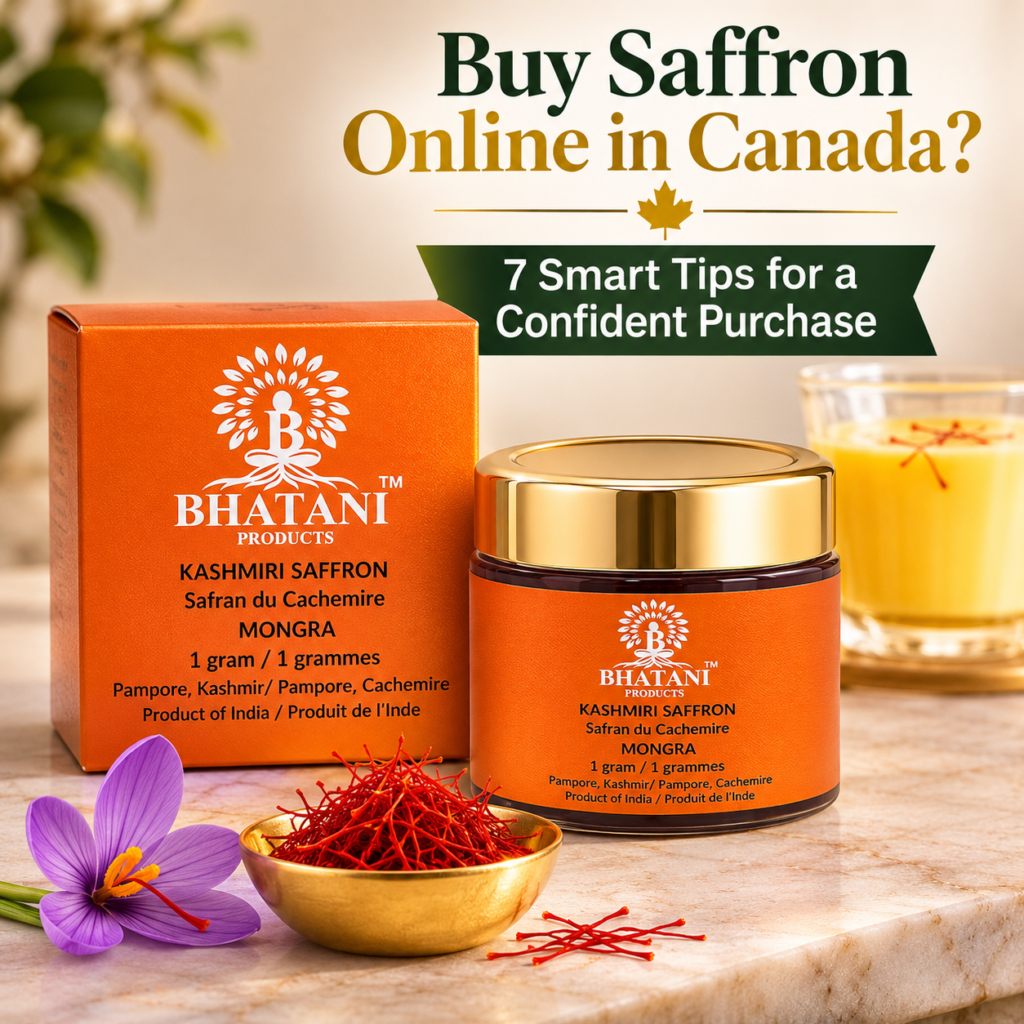
Planning to buy saffron online in Canada? You may find dozens of products claiming to be pure, premium or authentic Kashmiri Kesar. But how can you tell which seller deserves your trust before spending your money? This guide explains seven important questions every Canadian shopper should ask.
For Canadians shopping online, buying saffron can be surprisingly confusing. Product photographs look convincing, descriptions repeat words such as “pure,” “premium” and “authentic,” and customer reviews often tell conflicting stories.
The real question is not simply where to buy saffron. It is how to evaluate what a seller is offering before you pay. This guide explains the questions worth asking, the documents worth understanding and the warning signs worth noticing.
A beautiful product photograph may earn your attention. Clear, verifiable information should earn your trust.
Why Is Buying Saffron Online in Canada So Confusing?
Saffron comes from the dried stigmas of the Crocus sativus flower. Its distinctive aroma, flavour and colouring properties make it a valued culinary ingredient.
Because saffron is expensive to produce and sold in small quantities, it can also be vulnerable to economically motivated adulteration. Research has examined substitution with other plant materials, undeclared additions and artificial colouring.
A study published in Analytical and Bioanalytical Chemistry investigated laboratory methods for detecting botanical materials that could be used to substitute for or dilute saffron. Read the published research on saffron adulteration .
This does not mean every inexpensive product is fraudulent or every expensive product is genuine. It means shoppers should look beyond price and promotional language.
7 Questions to Ask Before Buying Saffron Online
Does the seller identify the saffron’s origin?
Look for a clear statement about where the saffron was grown or sourced. “Kashmiri style” is not the same statement as “grown in Kashmir.”
Can you see the actual product?
Photographs of the packaging, threads and net quantity are more informative than decorative images of flowers or generic spice bowls.
Is the quantity clearly stated?
Compare the price per gram, not simply the price of the jar. Packaging size can make small quantities appear larger.
Are quality claims explained?
If a seller advertises a grade, certification or laboratory result, look for information explaining what it means and what was tested.
Is the seller identifiable?
A business name, customer-service contact, clear policies and consistent product information make it easier to ask questions or resolve problems.
Is the packaging information consistent?
Compare the listing with the label. Look for the product name, net quantity and any relevant lot, storage or origin information supplied.
Are the promises realistic?
Be cautious of dramatic health promises, unexplained “world’s best” rankings or claims that a simple home test proves complete purity.
Does “Kashmiri Saffron” Always Mean It Comes From Kashmir?
Not necessarily. A product description may refer to geography, a style of presentation, a grade or a marketing association. These statements should not automatically be treated as equivalent.
If you specifically want Kashmiri Kesar, ask the seller to clarify the growing or sourcing origin. A company’s Canadian address tells you where the business operates, not necessarily where its saffron was cultivated.
The Canadian Food Inspection Agency’s guidance on origin claims explains that origin statements and claims about processing or packaging must be truthful and not misleading.
Questions worth asking a seller
- Where was this saffron grown?
- Is it sold as whole threads, cut threads or powder?
- What is the net weight?
- What information supports its advertised grade?
- Who can answer questions about the product?
What Does ISO 3632 Actually Tell You About Saffron?
ISO 3632 is an international standard used to assess specified characteristics of saffron. Its requirements address aspects such as composition and quality, including measurements associated with colour, flavour and aroma.
Three important saffron constituents often discussed in quality assessment are:
- Crocins: compounds associated with saffron’s colouring strength.
- Picrocrocin: associated with its characteristic bitter flavour.
- Safranal: an important contributor to its aroma.
These characteristics can be evaluated using defined analytical methods. The ISO 3632 standard was updated in 2025, so it is also worth checking which edition a seller’s documentation references.
However, an ISO-related grade or test result is not an unlimited guarantee against every possible form of adulteration. The meaning of a result depends on the methods used, the sample examined and the scope of testing.
For further scientific context, see Determination of Saffron Quality through a Multi-Analytical Approach .
Can a Laboratory Report Prove Saffron Is Genuine?
Laboratory testing can provide valuable evidence, but the words “lab tested” alone tell you very little. A useful report should allow the reader to understand what was examined.
Depending on the type of testing, a report may address colour strength, specified quality parameters, particular adulterants or other characteristics. Not every report tests for every possible issue.
How to read a saffron test report
- Identify the laboratory and report date.
- Check the sample description and any batch reference.
- Find the actual tests and methods used.
- Distinguish measured results from marketing claims.
- Ask whether the report relates to the product being sold.
A transparent seller should be able to explain its quality claims without relying on technical language that customers cannot verify.
Can You Test Saffron at Home?
You may have seen videos showing saffron threads placed in water, rubbed between fingers or examined for colour changes.
These observations can be interesting, but they are not definitive authenticity tests.
Genuine saffron can gradually release colour into water, but the rate depends on factors including temperature, quantity, processing and the condition of the threads. An adulterated product may also produce convincing colour.
Similarly, texture, aroma and taste may offer clues, but no single observation establishes that saffron is completely authentic or free from undeclared materials.
If you want a more detailed explanation of visual and sensory characteristics, read our guide to identifying pure saffron .
Home observations can raise questions. They should not replace reliable product information or appropriate analytical testing.
Is Expensive Saffron Always Better?
No. Price can reflect genuine differences in cultivation, harvesting, handling, sourcing, packaging and distribution. It can also reflect branding or retail markups.
A premium price is not proof of authenticity. Equally, a lower price does not automatically mean a product is adulterated.
When comparing products, calculate the price per gram and then compare the information provided by each seller.
Price alone
Tells you what you will spend, but little about origin, testing or the seller’s ability to support its claims.
Price plus transparency
Helps you evaluate quantity, sourcing information, product presentation, supporting documents and service.
If you are curious about the labour and agricultural factors behind saffron’s cost, explore our article on Kashmiri saffron and the Bhatani collection .
Marketplace, Specialty Store or Brand Website: Which Is Safer?
Each purchasing channel has advantages and limitations. None automatically guarantees genuine saffron.
Online marketplaces
Marketplaces can make price comparisons, customer reviews and delivery options convenient. However, listings may differ in the amount of information provided, and reviews are not substitutes for evidence about authenticity.
Specialty food retailers
A knowledgeable retailer may help explain culinary uses, product varieties and sourcing. Ask the same questions you would ask any online seller.
Direct-from-brand websites
Buying directly from a brand can make it easier to find its product information, contact details and policies in one place. But a polished website is not proof of quality; the claims still need support.
The best channel is the one that gives you clear product information, reasonable purchase protections and a seller who can answer your questions.
Five Warning Signs to Notice Before Checkout
- Vague origin claims: Geographic names appear repeatedly, but the seller cannot explain where the saffron was sourced.
- Unclear quantity: The listing emphasizes jar size without making the net weight easy to find.
- Unsupported guarantees: Claims such as “100% pure” or “highest grade” appear without meaningful supporting information.
- Unrealistic health promises: The listing presents saffron as a cure or treatment for medical conditions.
- Inconsistent information: The product images, description and packaging do not agree.
One warning sign does not necessarily establish fraud. It is a reason to ask questions before purchasing.
What Should You Check When Your Saffron Arrives?
Your evaluation should continue after delivery. Before opening the package, compare it with the product you ordered.
Arrival checklist
- Confirm that the product and quantity match the order.
- Inspect the container and seal for damage.
- Review the available product and storage information.
- Keep the order confirmation and packaging if you have concerns.
- Contact the seller if something appears inconsistent.
Store saffron according to the package directions. In general, keeping dried saffron sealed and protected from moisture, excessive heat and direct light helps preserve its culinary qualities.
Why Bhatani Believes Education Should Come Before a Sale
At Bhatani Products, we believe customers deserve to understand what they are purchasing rather than rely entirely on attractive packaging or promotional promises.
Our Kashmiri saffron collection is presented for customers who appreciate the distinctive character of Kesar and want to make considered purchasing decisions.
We encourage you to explore the product details, compare available information and contact us with questions before deciding whether Bhatani is right for you.
Choose With Knowledge. Buy With Confidence.
Discover Bhatani Kashmiri Saffron and explore a thoughtful approach to everyday culinary rituals.
Heritage Refined.
Frequently Asked Questions
Where can I buy saffron online in Canada?
You can buy saffron from specialty food retailers, online marketplaces and brand websites serving Canadian customers. Compare net quantity, origin information, seller transparency and return policies before purchasing.
How do I know whether online saffron is genuine?
Start with clear product information, credible sourcing claims and any relevant supporting documentation. Visual checks can provide clues, but cannot conclusively establish authenticity.
Is Kashmiri Kesar the same as saffron?
Kesar is a commonly used South Asian name for saffron. Kashmiri Kesar generally refers to saffron associated with Kashmir, but shoppers should verify the seller’s specific origin claims.
Does ISO 3632 certification guarantee pure saffron?
ISO 3632 provides standardized specifications and testing approaches for saffron quality. A test or grade should be interpreted according to its scope; it does not automatically rule out every possible authenticity issue.
Is saffron cheaper on Amazon than on brand websites?
Prices vary by seller, quantity, sourcing and promotions. Compare the current price per gram alongside product information, shipping and purchase protections rather than assuming one channel is always cheaper.
Can the water test identify fake saffron?
A water test can show how a sample releases colour, but it is not conclusive proof of authenticity. Some adulterated products may imitate the appearance of genuine saffron.
Final Thoughts: Trust Should Be Earned Before Checkout
Buying saffron online in Canada does not have to be a guessing game. You may not be able to verify every characteristic from a product listing, but you can ask better questions.
Look for clear origin information, meaningful product details, understandable quality claims and a seller willing to communicate.
The best purchase is not necessarily the cheapest or the most expensive. It is the one you can make with confidence in the information available.
Editorial note: This article provides general consumer education about saffron as a culinary ingredient. Home observations do not replace laboratory authentication. Product quality, origin and test claims should be assessed individually. This content is not medical advice.