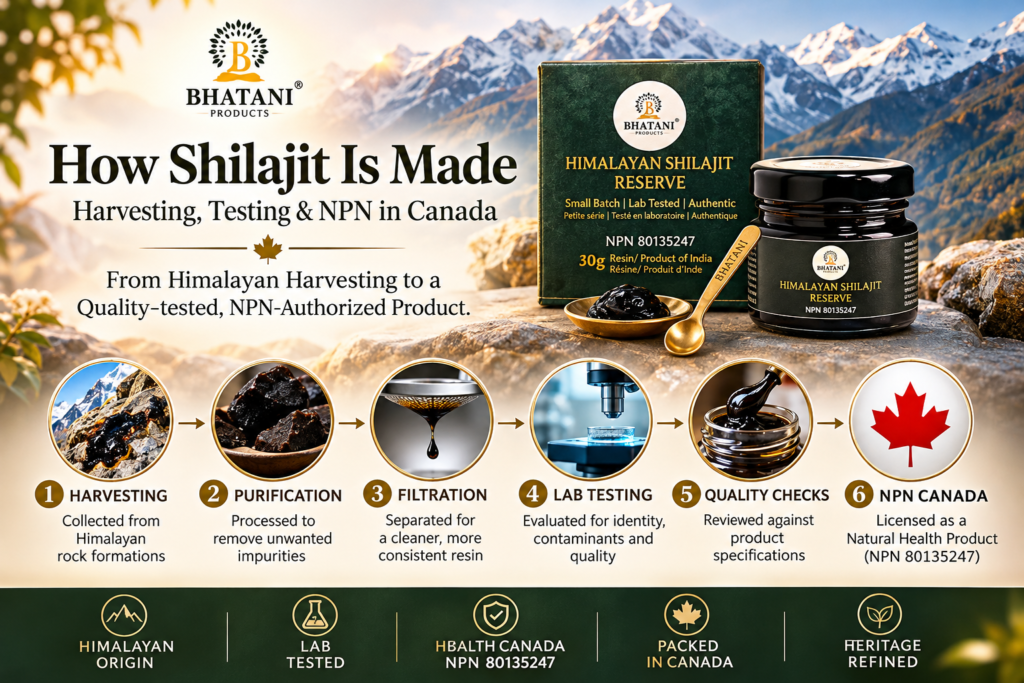
How is Shilajit made? Before this dark, resin-like substance reaches a jar, there is a journey involving natural formation, mountain collection, purification, quality testing and packaging. For Canadians considering Shilajit, understanding that journey can be more useful than relying on advertising claims or appearance alone.
Shilajit is not manufactured from a single ingredient in the way a conventional supplement blend might be. It is a naturally occurring substance collected from certain mountainous environments and subsequently processed into a finished product.
But the words raw, purified, lab tested and authentic do not all mean the same thing. Each describes a different aspect of the material or the process.
This guide explains how Shilajit is generally harvested and prepared, why testing matters, and how Canadian natural health product requirements fit into the picture.
We will also explain how Bhatani Himalayan Shilajit Reserve approaches product information and transparency under our philosophy, Heritage Refined.
“Understanding what happens before a product reaches the jar is part of making an informed choice.”
What Is Shilajit Made From?
Shilajit is a naturally occurring, complex organic-mineral substance found in certain mountain environments, including the Himalayas.
It is commonly described as a dark material associated with rock formations and long-term biological and geological processes.
Researchers have discussed the contribution of decomposed organic material, microorganisms, surrounding minerals and environmental conditions to its formation. However, Shilajit’s precise formation mechanisms and chemical composition can vary and remain subjects of scientific investigation.
Rather than being a single purified chemical, Shilajit is a mixture of different constituents.
Humic Substances
Shilajit may contain humic substances, including fractions commonly described as fulvic and humic acids.
Mineral Constituents
Mineral composition can differ according to the source material and surrounding geological environment.
Organic Compounds
Different samples may contain a range of naturally occurring organic compounds in varying proportions.
Not a Fixed Formula
Shilajit does not have one identical composition across all sources, batches or manufacturing methods.
This natural variability is one reason that identifying the material and evaluating its quality are important.
Where Does Himalayan Shilajit Come From?
Shilajit has been reported in several mountainous regions of Asia and elsewhere. Himalayan Shilajit is associated with rock formations in the Himalayan region.
The exact source location matters because natural materials may differ in composition and potential environmental exposure.
However, a mountain photograph, a high-altitude claim or the word “Himalayan” is not sufficient evidence of product identity or safety.
Geographical Origin
The region from which a raw material is collected helps establish its sourcing history.
Rock and Soil Conditions
Local geological and environmental conditions may influence the material’s composition.
Handling Practices
The way material is collected, transported and stored can affect its condition before processing.
Documentation
Supplier records and appropriate testing provide more useful information than origin claims alone.
How Is Shilajit Harvested?
Shilajit is commonly collected from deposits associated with exposed mountain rock surfaces and crevices.
Collection methods depend on the terrain, accessibility, season and characteristics of the material.
The material gathered at this stage is generally described as raw Shilajit.
It may contain soil, sediment, rock particles and other unwanted substances from its natural environment.
Because collection conditions vary, consumers should be cautious of claims that every Shilajit product is harvested in exactly the same way or at a particular altitude.
Is Higher-Altitude Shilajit Always Better?
No universal altitude threshold establishes that Shilajit is automatically safer or higher quality.
Altitude alone does not establish identity, contaminant levels, manufacturing quality or suitability for consumption.
These questions require appropriate evidence rather than a geographical marketing claim.
Why Does Raw Shilajit Need Purification?
Raw Shilajit is not the same as a finished, quality-controlled natural health product.
Natural collection can introduce unwanted particulate material and potential contaminants. Appropriate processing is intended to improve the suitability and consistency of the material for its intended use.
But purification is not a guarantee that every contaminant has been removed.
A responsible quality system must consider the source material, the processing method, the finished product specifications and the testing needed to evaluate the final product.
“Raw does not automatically mean pure. Processed does not automatically mean safe. Evidence matters.”
Is Raw Shilajit Better Than Purified Shilajit?
Not necessarily. The idea that less processing always means better quality can be misleading when discussing naturally collected materials.
A finished product should be assessed on relevant quality criteria rather than judged solely by whether it is described as raw, natural or traditionally prepared.
How Is Shilajit Purified and Made Into Resin?
There is no single universal manufacturing procedure used by every Shilajit producer.
Some processes described for Shilajit involve water-based extraction or dissolution, separation of insoluble material, filtration and controlled concentration.
The sequence below is an illustrative overview of possible processing stages, not a verified description of Bhatani’s proprietary supplier process.
Raw Material Inspection
The collected material may be examined and assessed before entering a processing operation.
Extraction or Dissolution
Certain processing methods use water to separate soluble material from some insoluble components.
Separation
Sedimentation, filtration or other suitable methods may be used to separate unwanted particulate material.
Concentration
Depending on the manufacturing method, water may be removed to produce a thicker, resin-like consistency.
Quality Assessment
The processed material is evaluated against relevant specifications and quality requirements.
Packaging and Records
Finished products are packaged, labelled and documented according to applicable requirements.
Manufacturers may use different validated methods, and not every process involves every stage listed above.
The important question is not whether a product was made using a fashionable processing term. It is whether the manufacturer has appropriate controls and evidence that the finished product meets its specifications.
For Canadian requirements, Health Canada’s Quality of Natural Health Products Guide explains the quality expectations relevant to natural health products.
How Is Shilajit Tested for Quality?
Shilajit’s appearance cannot tell you everything about its identity or contaminant levels.
A very dark colour, sticky consistency or distinctive smell is not a substitute for laboratory analysis.
Quality testing should be appropriate to the particular product, its specifications and the risks associated with the raw material.
Heavy Metals
Testing may evaluate contaminants such as lead, arsenic, cadmium and mercury against applicable limits.
Microorganisms
Appropriate tests may assess microbial counts or specified microorganisms relevant to the product.
Identification
Suitable methods can help establish whether the tested material meets its defined identity specifications.
Physical and Chemical Properties
Tests may assess relevant characteristics such as moisture, composition or other specification parameters.
What Is a Shilajit Certificate of Analysis?
A Certificate of Analysis, often called a COA, records the results of specified tests performed on a material or product.
A useful COA should help identify what was tested, which methods or specifications were used, the results and the batch or sample to which the report applies.
A COA does not necessarily establish every aspect of product safety or quality. Its value depends on the tests performed, the methods used, the laboratory and the connection between the report and the product being sold.
For information about Bhatani’s quality documentation, visit our Certificates and Quality Information page.
Does Fulvic Acid Percentage Prove Shilajit Is Authentic?
Not by itself.
Fulvic acid is a group of naturally occurring substances associated with humic materials, but a single reported percentage cannot independently establish geographical origin, absence of contaminants or overall product quality.
Testing methods and the meaning of reported results also matter. Consumers should avoid treating one laboratory number as a complete quality assessment.
What Does Health Canada Require for Natural Health Products?
In Canada, natural health products are subject to a regulatory framework that includes product licensing and applicable manufacturing, packaging, labelling and quality requirements.
Health Canada’s Good Manufacturing Practices Guide for Natural Health Products (GUI-0158) describes expectations for quality systems, personnel, premises, equipment, sanitation, operations, quality assurance and records.
The updated guide became effective on March 4, 2026.
These requirements help explain why a finished product involves more than collecting material and placing it in a jar.
What Canadian Quality Requirements Consider
- Product specifications: Defined requirements for the finished product.
- Quality assurance: Appropriate review and controls before product release.
- Manufacturing practices: Suitable procedures, equipment and handling.
- Records: Documentation supporting production, testing and traceability.
- Labelling: Required product information and directions.
Learn more from Health Canada’s natural health product site licensing guidance.
What Does NPN Mean on Shilajit in Canada?
NPN stands for Natural Product Number.
It is an eight-digit identifier assigned to a natural health product after Health Canada grants the relevant product licence.
A product licence indicates that Health Canada has reviewed the product for safety, efficacy and quality under its recommended conditions of use.
It does not mean the government endorses the brand or guarantees that the product is suitable for every individual.
Bhatani Himalayan Shilajit Reserve 30g carries NPN 80135247.
You can learn more about product authorization through Health Canada’s Licensed Natural Health Products Database.
For readers who want to understand the broader licensing process, see Health Canada’s Product Licensing guidance.
From Product of India to Packed in Canada: Understanding Bhatani’s Label
A product’s source country and packaging country describe different parts of its journey.
Bhatani Himalayan Shilajit Reserve is labelled Product of India and Packed in Canada.
These statements should not be confused with a claim that the raw material originates in Canada.
The packaging also identifies the product and includes information intended to help customers recognize and trace their jar.
This is part of our Know Your Jar philosophy: understand the product information rather than relying on appearance alone.
Explore our related article, Before You Buy Shilajit: Know Your Jar, for a closer look at what consumers can check on their packaging.
What Is the Bhatani Standard?
At Bhatani Products, our approach is grounded in Heritage Refined: respecting the history of a natural material while emphasizing clear information and responsible product presentation.
For our Himalayan Shilajit Reserve, that means communicating important details such as its resin format, stated origin, Canadian packaging, product authorization and available quality documentation.
Our commitment to transparency is not a claim that every manufacturing detail can be verified by looking at the jar.
Instead, we encourage customers to ask useful questions and review relevant information.
The Bhatani Standard: Questions Worth Asking
- Where does the product originate?
- What form of Shilajit am I purchasing?
- What testing information is available?
- Can I identify the product’s batch?
- What directions and precautions appear on the label?
- Where can I find reliable information about the product?
Review our Certificates page for more information about Bhatani’s quality approach.
How Can You Choose Shilajit in Canada?
Understanding the production journey can help you evaluate a Shilajit product without relying on exaggerated advertising or unverified assumptions.
Before purchasing, review the product’s identity, directions, precautions, source information and available quality documentation.
You may also find our guide Buying Shilajit in Canada? 7 Mistakes to Avoid useful for understanding common purchasing pitfalls.
If you are considering Bhatani Himalayan Shilajit Reserve, explore the product details and determine whether it is appropriate for your needs.
Know What Goes Into Your Choice.
Discover Bhatani Himalayan Shilajit Reserve 30g, explore our quality information and make an informed decision about your personal wellness ritual.
EXPLORE BHATANI SHILAJITFrequently Asked Questions About How Shilajit Is Made
How is Shilajit made?
Shilajit forms naturally in certain mountainous environments. Collected material is then processed using methods appropriate to the manufacturer and assessed against relevant quality specifications before becoming a finished product.
Where does Himalayan Shilajit come from?
Himalayan Shilajit is associated with deposits found in the Himalayan region. Exact source locations and material characteristics can vary.
Is Shilajit harvested from rocks?
Shilajit is commonly collected from material associated with mountain rock surfaces and crevices. Collection practices depend on the source and conditions.
Why is Shilajit purified?
Processing helps address unwanted material associated with natural collection. The effectiveness of a particular process must be supported by suitable controls and testing.
How is Shilajit turned into resin?
Some processing methods use extraction, separation and controlled concentration to produce a resin-like finished material. Procedures vary between manufacturers.
What tests are performed on Shilajit?
Depending on the product and applicable specifications, testing may address identity, chemical contaminants, microbial quality and other relevant characteristics.
Can you tell if Shilajit is pure by its colour?
No. Colour and texture alone cannot establish identity, contaminant levels or compliance with product specifications.
What is a Shilajit Certificate of Analysis?
A COA is a document reporting specified test results for an identified sample or batch. Its usefulness depends on the tests, methods and traceability information provided.
Does Shilajit need an NPN in Canada?
Natural health products marketed in Canada generally require the applicable product authorization. Licensed products display an NPN, or another relevant authorization number depending on the product category.
Is Bhatani Shilajit made in Canada?
Bhatani Himalayan Shilajit Reserve is labelled Product of India and Packed in Canada. These statements describe different stages of the product’s journey.
From Natural Material to Finished Jar: Why the Details Matter
Shilajit’s journey involves more than its geographical origin.
The way raw material is collected, processed, evaluated, documented and packaged all contribute to understanding the finished product.
For Canadian consumers, the most useful approach is to look beyond dramatic marketing language and ask what information can actually be verified.
That is the thinking behind Bhatani’s commitment to Beyond the Label, Know Your Jar and the Bhatani Standard.
“Heritage deserves respect. Quality deserves evidence. Trust deserves transparency.”
Bhatani Products — Heritage Refined.
Educational Disclaimer: This article is for general educational purposes only and does not constitute medical advice, diagnosis or treatment. Manufacturing processes described here are general examples and should not be interpreted as a verified description of Bhatani’s supplier-specific procedures. Natural health products may have contraindications, adverse effects or interactions. Always follow the directions and cautions on the product label. Consult a qualified healthcare professional before using Shilajit if you are pregnant or breastfeeding, take medication, have an existing medical condition or are uncertain whether the product is appropriate for you. Health Canada product authorization is not a government endorsement of a brand.