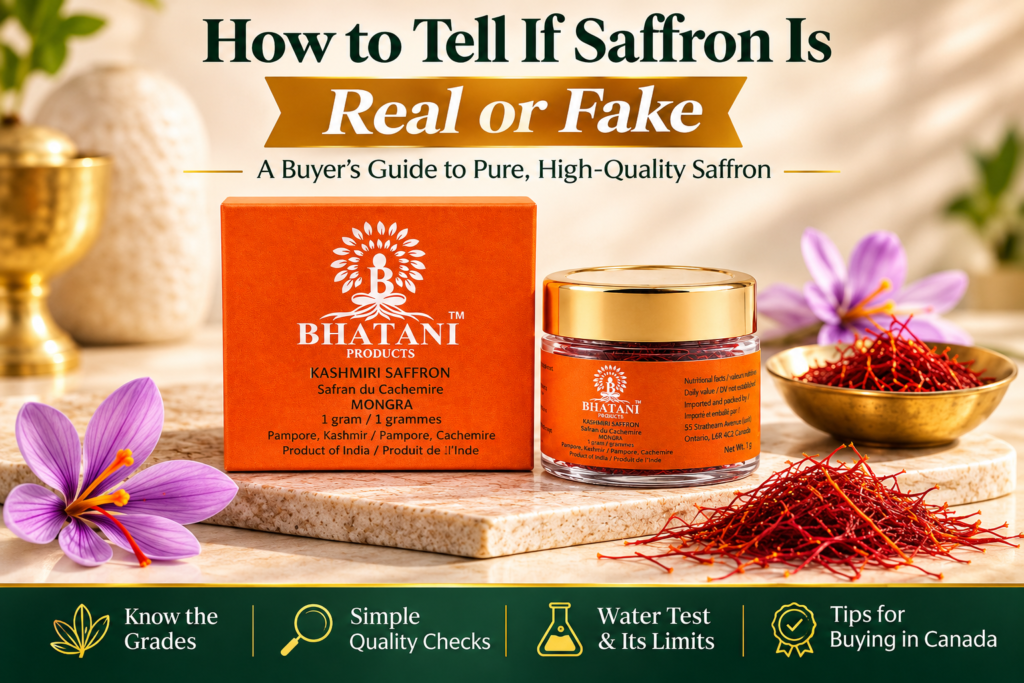
You paid a premium for saffron. The threads look beautifully red, the aroma seems convincing, and the seller promises exceptional quality. But how can you tell if the saffron is real? And can a simple water test actually reveal the truth?
Saffron is one of the world’s most valuable spices by weight. Its distinctive colour, aroma, and flavour come from the dried stigmas of the Crocus sativus flower. Each flower produces only three stigmas, and harvesting them requires considerable care and labour.
That value also creates opportunities for adulteration. Some products may contain dyed plant fibres, added colouring agents, excess floral material, or other substances sold as saffron.
For Canadians buying saffron online, the challenge is understanding which quality indicators are meaningful and which popular authenticity tests can be misleading.
This guide explains how to tell if saffron is real, what to look for in Kashmiri saffron, and why laboratory analysis provides stronger evidence than appearance alone.
Real saffron is more than a beautiful red thread. Understanding its origin, structure, aroma, and quality assessment helps you make a more informed purchase.
How to Tell If Saffron Is Real: 5 Things to Examine
Before buying saffron, start with the characteristics that can be observed without specialised equipment.
These observations can help identify suspicious products, but they cannot conclusively establish authenticity or purity.
Thread Structure
Genuine saffron stigmas typically have an irregular, tapered structure, often widening toward one end. Uniform, straight fibres may warrant closer examination.
Colour
High-quality red-stigma saffron generally has deep crimson colouring. However, colour alone cannot establish purity because dyes can imitate the appearance of genuine threads.
Aroma
Saffron has a distinctive, complex aroma often described as floral, hay-like, honeyed, and earthy. An unusually artificial fragrance may raise questions.
Moisture & Condition
Properly dried saffron should not appear excessively damp, mouldy, or sticky. Storage conditions can affect texture, fragrance, and quality over time.
Seller Information
Look for clear product identification, declared origin, packaging information, and credible quality documentation where available.
What Does Real Saffron Look Like?
Authentic saffron consists of the dried stigmas of the saffron crocus. A stigma is not simply a red fibre: it has a characteristic botanical structure that can be examined under magnification.
The stigma may appear broader toward its upper end and narrower toward the base. Depending on how the saffron is processed, part of the lighter-coloured style may remain attached.
This distinction matters because genuine saffron can include some yellow or orange floral material without automatically being counterfeit.
However, products sold specifically as red-stigma saffron should be evaluated against the description and grade claimed by the seller.
What Is Kashmiri Mongra Saffron?
Kashmiri saffron is associated with saffron cultivation in the Kashmir region of India. It is valued for its culinary heritage, distinctive characteristics, and regional identity.
One commonly recognised style is Mongra saffron, which generally refers to separated red stigmas with most or all of the lighter style removed.
Other regional names, including Lacha and Guchi, describe different forms of saffron presentation and processing.
Mongra vs. Lacha vs. Guchi: What’s the Difference?
Mongra Saffron
Generally consists of separated red stigmas with the lighter style removed. It is sought after for its concentrated red-stigma presentation and culinary characteristics.
Lacha Saffron
Typically retains red stigmas together with a portion of the yellowish or orange style. Its appearance differs from fully separated red-stigma saffron.
Guchi Saffron
Commonly refers to saffron threads tied or grouped into bundles, often retaining portions of the style. The presentation is distinct from separated Mongra threads.
These are traditional or commercial descriptions, not universal equivalents of ISO Grade I, II, or III.
A product described as Mongra is not automatically proven to meet the highest analytical quality category. That requires appropriate testing and documentation.
Can You Identify Pure Saffron With a Water Test?
The water test is one of the most frequently shared methods for identifying real saffron. It is also one of the most misunderstood.
When saffron is placed in water, its naturally occurring pigments gradually colour the liquid, typically producing yellow to golden-orange tones.
But the speed and appearance of that colour release can vary with water temperature, the condition of the threads, quantity, and preparation.
How to Observe Saffron in Water
- Step 1: Place a few saffron threads in a clean, transparent glass.
- Step 2: Add warm water.
- Step 3: Observe how the colour develops over several minutes.
- Step 4: Examine the remaining threads and note their appearance.
- Step 5: Treat the result as an observation, not a certificate of authenticity.
A suspicious colour release or unusual thread behaviour may justify further investigation. However, a convincing golden colour does not prove that a product is genuine or free from adulterants.
Can Fake Saffron Pass the Water Test?
Yes. A counterfeit or adulterated product can sometimes produce a colour that resembles genuine saffron.
This is why a water test should not be treated as definitive proof.
Adulteration can involve materials designed to resemble saffron visually or substances that imitate some of its colouring properties.
Conversely, genuine saffron may behave differently depending on how it was dried, stored, or prepared.
A home test cannot reliably identify all added dyes, undeclared plant materials, or chemical contaminants.
The water test can raise questions. It cannot answer every question about saffron purity.
Does Real Saffron Have a Sweet Smell?
Genuine saffron often has a distinctive aroma that people describe using words such as honey, hay, floral, earthy, or slightly medicinal.
An important contributor to its aroma is safranal, a volatile compound associated with saffron’s characteristic fragrance.
But aroma is subjective. Storage, age, drying, and individual perception can influence how saffron smells.
A pleasant aroma is therefore a useful sensory characteristic, not definitive evidence of purity.
What Does Real Saffron Taste Like?
Saffron contributes a distinctive flavour to food and beverages. It is generally associated with mildly bitter, earthy, and aromatic notes rather than a sugary taste.
However, taste is not a reliable authentication method. Added substances can alter flavour, and a person’s ability to distinguish subtle notes varies.
Do not taste an unknown or suspicious product solely to determine whether it is authentic.
Why Are Baking Soda and Other Internet Tests Unreliable?
Online videos sometimes recommend baking soda, rubbing threads between fingers, or examining how saffron behaves in various liquids.
These demonstrations can appear convincing, but they do not provide a validated method for identifying every form of saffron adulteration.
Different substances can produce similar reactions, and genuine saffron may vary in its behaviour.
For a meaningful assessment of authenticity, laboratory methods are more appropriate than improvised kitchen experiments.
How Do Laboratories Test Saffron Quality?
Professional saffron quality assessment can involve chemical analysis, physical examination, and methods designed to identify adulteration.
One important international reference is the ISO 3632 series, which addresses specifications and testing methods for saffron.
Quality assessments commonly examine characteristics associated with colouring strength, bitterness, aroma, and other measurable properties.
Crocin-Related Compounds
Crocin and related carotenoid compounds contribute to saffron’s colouring properties. Analytical measurements can help assess colouring strength.
Picrocrocin
Picrocrocin is associated with saffron’s characteristic bitterness and is one of the compounds considered in quality assessment.
Safranal
Safranal contributes to saffron’s distinctive aroma. Its measurement can provide information about aromatic characteristics.
These measurements help describe saffron quality, but they should not be confused with proof of medicinal effectiveness.
Likewise, a general business certification is not the same as a product-specific saffron authentication test.
For information about the relevant international standards, consult the International Organization for Standardization’s ISO 3632 resources.
Does a Higher Saffron Grade Always Mean Better Saffron?
Not necessarily in every sense.
A recognised analytical grade can communicate important information about certain measured characteristics. However, the best choice for a particular customer also depends on freshness, intended culinary use, storage, origin preferences, and seller reliability.
A high grade should not be interpreted as proof that saffron will provide superior health outcomes.
Nor should a regional trade name be treated as equivalent to independently verified laboratory results.
Is Kashmiri Saffron Better Than Iranian or Spanish Saffron?
Kashmiri, Iranian, Spanish, and other saffron-producing regions have distinct agricultural histories and commercial traditions.
Growing conditions, cultivation practices, harvesting, processing, and storage can influence saffron characteristics.
Kashmiri saffron is highly valued by many consumers, particularly those who appreciate its regional heritage.
However, geographic origin alone does not prove that one product is superior to every product from another region.
Consumers should evaluate the individual saffron product rather than relying exclusively on national or regional comparisons.
Should You Buy Saffron Threads or Powder?
Whole threads are often a practical choice for customers who want to examine the product before use.
With threads, it is easier to observe the botanical structure, colour variation, and condition of the material.
Powdered saffron can be convenient for cooking, but grinding removes many of the visible characteristics that help consumers examine the product.
This does not mean all powdered saffron is adulterated. It means that evaluating it visually is more difficult.
Before Buying Saffron in Canada
- Check the product description: Is it whole-thread saffron or powder?
- Confirm the declared origin: Look for clear and consistent sourcing information.
- Understand the grade: Ask whether a claimed grade is a regional description or supported by analytical testing.
- Examine the packaging: Choose packaging that helps protect the spice from light, moisture, and air.
- Review seller transparency: Look for product information and supporting documentation where available.
- Be cautious of absolute promises: Claims such as “100% guaranteed pure by water test” should not replace meaningful quality evidence.
How Should You Store Pure Saffron?
Even genuine, high-quality saffron can lose desirable characteristics when stored poorly.
Light, heat, moisture, oxygen, and repeated exposure to air can affect the quality of dried spices over time.
To help preserve saffron:
- Keep it in a tightly closed, food-safe container.
- Store it in a cool, dry cupboard away from direct sunlight.
- Avoid placing it near a stove or other heat source.
- Use clean, dry utensils when handling the threads.
- Follow any storage instructions and best-before information on the package.
For most home kitchens, a stable, dry cupboard is preferable to repeatedly moving saffron between warm and cold environments where condensation may occur.
Why Does Saffron Cost So Much?
Saffron’s price reflects several factors, including the labour involved in harvesting and separating the stigmas, the quantity of flowers required, cultivation conditions, processing, and distribution.
Each saffron crocus produces only three stigmas. Gathering enough dried material for commercial quantities requires substantial manual work.
However, price is not an authentication test. An expensive product can still be misrepresented, while a lower price does not automatically establish that a product is counterfeit.
The better approach is to consider price alongside product identity, quality information, and seller transparency.
What Makes Bhatani Kashmiri Saffron Different?
At Bhatani Products, our interest in Kashmiri saffron begins with its regional heritage and the care associated with this distinctive spice.
We offer Kashmiri saffron for customers who value the experience of whole saffron threads, their culinary versatility, and the tradition behind the ingredient.
We encourage customers to understand what they are purchasing, how to use it, and how to store it properly.
For more information about our saffron collection, explore Bhatani Products.
Discover Kashmiri Saffron With Confidence.
A remarkable spice deserves more than exaggerated promises. Explore Bhatani Kashmiri Saffron and learn about the ingredient, its heritage, and its place in the kitchen.
EXPLORE BHATANI SAFFRONFrequently Asked Questions About Pure Saffron
How can I tell if saffron is real?
Examine the thread structure, colour, aroma, packaging, and seller information. These observations may help identify suspicious products, but reliable authentication may require laboratory analysis.
Does pure saffron turn water yellow or red?
Genuine saffron commonly produces yellow to golden-orange colouring in water. However, the appearance and rate of colour release vary, and colour alone cannot prove authenticity.
Can fake saffron look exactly like real saffron?
Some adulterated products can closely resemble genuine saffron. Visual examination may not identify every form of adulteration.
What is Mongra saffron?
Mongra is a regional commercial description generally used for separated red saffron stigmas with the lighter style removed. It is not automatically equivalent to a particular ISO quality category.
Is Kashmiri saffron always the best?
Kashmiri saffron has a valued regional heritage, but quality varies between products. Origin alone does not establish that one saffron product is superior to all others.
Can baking soda detect fake saffron?
Baking soda demonstrations are not a reliable substitute for validated saffron authentication methods. They should not be used to certify purity.
Is saffron powder less pure than saffron threads?
Not necessarily. Genuine saffron can be sold as powder, but powdered products are more difficult to assess visually because the original thread structure is no longer visible.
What does ISO 3632 mean for saffron?
ISO 3632 is an international standards series addressing saffron specifications and testing methods. It provides a framework for evaluating certain quality characteristics, but claims of compliance should be supported by appropriate evidence.
How long does saffron stay fresh?
Quality depends on processing, packaging, and storage. Keep saffron protected from light, heat, air, and moisture, and follow the best-before and storage information supplied with the product.
The Final Word: Choose Evidence Over Internet Tricks
Learning how to tell if saffron is real begins with understanding the spice itself.
Thread structure, aroma, colour, and presentation can provide useful clues. But none of these observations can independently establish every aspect of purity.
For Canadian customers, the strongest purchasing decisions combine product knowledge, realistic expectations, credible quality information, and transparent sellers.
The beauty of saffron is in its details. The confidence to buy it comes from understanding those details.
Further Reading
- International Organization for Standardization — ISO 3632 saffron standards
- Canadian Food Inspection Agency — Food labelling information
Educational Disclaimer: This article provides general information about saffron identification, quality, and culinary purchasing considerations. Home observations cannot establish product purity, safety, or authenticity with certainty. Statements about botanical compounds and quality measurements should not be interpreted as medical claims or proof of therapeutic effectiveness. Consult a qualified healthcare professional before using saffron for health-related purposes, particularly during pregnancy or when taking medication.