What Is ISO 3632 Saffron Testing?
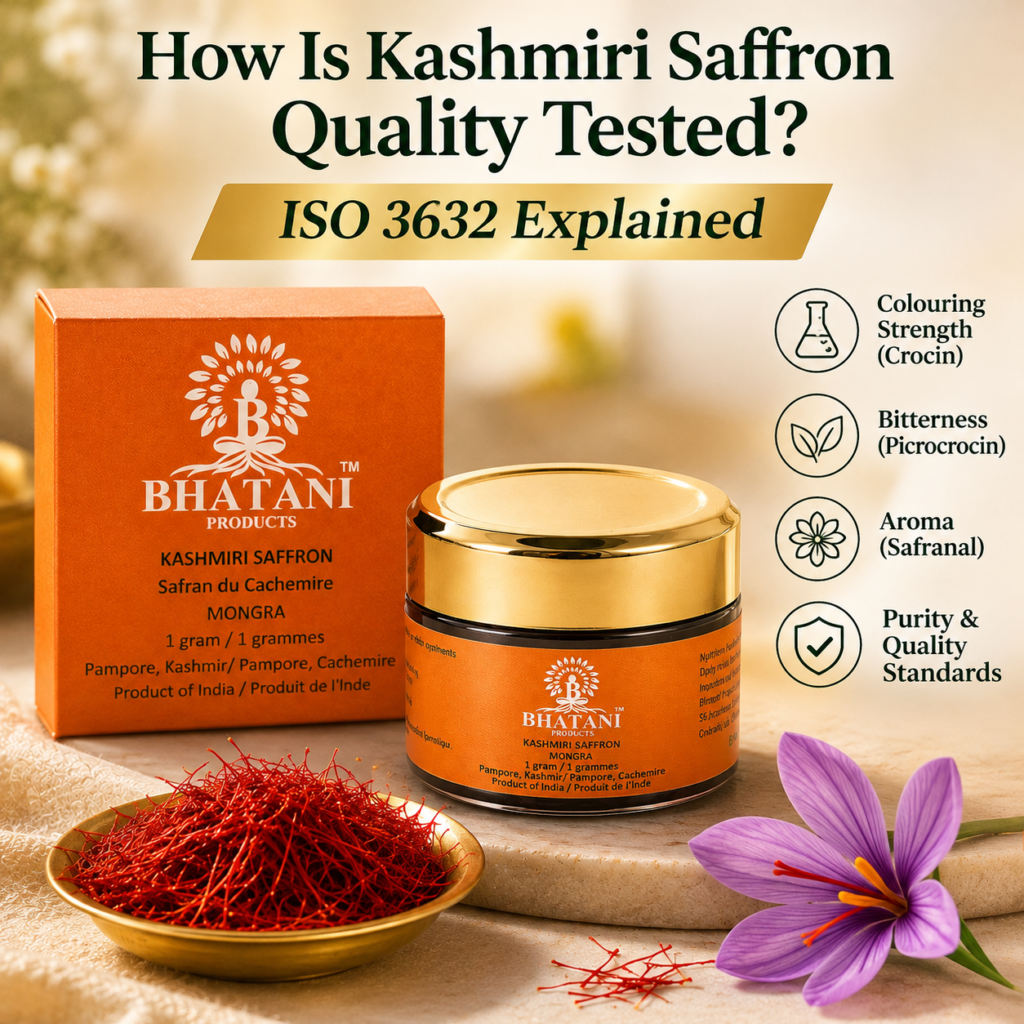
ISO 3632 saffron testing helps buyers understand how Kashmiri saffron quality is evaluated. But what do laboratory measurements actually reveal? From colouring strength and bitterness to aroma, moisture and purity, this guide explains the international grading standards that Canadian customers should understand before purchasing premium saffron.
From saffron-infused water to homemade facial masks, the internet is full of suggestions for achieving a brighter-looking complexion. Some are simple cultural beauty rituals; others promise dramatic results without adequate scientific support.
This guide explores the science behind saffron and skin appearance, how saffron is used in skincare, what to know about dark spots and acne, and how to approach traditional beauty rituals safely.
Saffron for Glowing Skin: The Short Answer
- Saffron contains naturally occurring pigments and aromatic compounds, including crocin, crocetin, and safranal.
- Researchers have investigated some saffron constituents for antioxidant and other biological activity.
- Early findings do not establish that ordinary saffron threads brighten skin, remove dark spots, or treat acne.
- Eating saffron and applying a formulated saffron skincare product are not equivalent.
- Sun protection, gentle skincare, and appropriate treatment of underlying skin conditions remain important.
Why Is Saffron Associated With Glowing Skin?
Saffron comes from the dried stigmas of Crocus sativus, a flowering plant cultivated in several regions of the world, including Kashmir.
Its striking red threads release golden-yellow colour when infused in liquid. This distinctive appearance, together with its fragrance and cultural history, has helped saffron become associated with beauty and personal-care rituals.
However, the colour saffron releases into water should not be confused with an ability to change skin pigmentation.
When people describe “glowing skin,” they may be referring to several different characteristics: an even-looking complexion, smooth texture, adequate hydration, or the way light reflects from the skin’s surface.
These characteristics are influenced by many factors, including genetics, age, environmental exposure, skincare habits, and underlying skin conditions.
What Does Science Say About Saffron and Skin?
Scientists have investigated saffron and its constituents in laboratory studies involving oxidative processes, inflammatory signalling, and other biological mechanisms.
Some experiments suggest that particular saffron-derived compounds may influence pathways relevant to skin biology.
These findings are scientifically interesting, but they do not establish that applying ordinary culinary saffron to the face will produce a measurable improvement in skin appearance.
What Is Crocin?
Crocin is a naturally occurring carotenoid compound associated with saffron’s characteristic colour.
Researchers have investigated crocin in experimental systems for several biological activities, including antioxidant-related effects.
However, the amount present, its stability, and how it behaves in a formulated product all matter when considering possible applications.
What Is Crocetin?
Crocetin is another carotenoid associated with saffron.
It has been studied in experimental research, but findings involving isolated crocetin cannot automatically be applied to whole saffron threads or homemade facial preparations.
What Is Safranal?
Safranal is an aromatic compound that contributes to saffron’s distinctive fragrance.
Although it has attracted scientific interest, its presence does not establish that saffron improves skin health or appearance.
Crocin
A carotenoid associated with saffron’s colour and investigated in experimental biological research.
Crocetin
A saffron-associated compound studied in laboratory research, with limited direct evidence for everyday skincare use.
Safranal
An aromatic constituent responsible for part of saffron’s characteristic fragrance.
The presence of an interesting natural compound does not automatically mean a homemade skincare preparation will deliver a proven result.
Can Saffron Brighten Skin or Remove Dark Spots?
Dark spots and uneven pigmentation are common skincare concerns.
They may result from sun exposure, previous inflammation, acne, hormonal changes, or other factors.
Some preliminary research has examined saffron-derived compounds in relation to pigmentation-related pathways.
However, there is insufficient reliable clinical evidence to conclude that applying culinary saffron removes dark spots or produces predictable skin-lightening effects.
Does Saffron Change Your Natural Skin Colour?
There is no convincing clinical evidence that ordinary dietary or topical saffron use permanently changes a person’s natural skin colour.
Skin tone is influenced by melanin production and many biological and environmental factors.
Claims that saffron can dramatically whiten or transform the complexion should be approached with caution.
What Helps Prevent Dark Spots From Becoming Worse?
Consistent sun protection is important because ultraviolet exposure can worsen many pigmentation concerns.
For persistent or changing dark spots, a dermatologist can help identify the cause and recommend suitable treatment.
How to Use Saffron for Glowing Skin: Three Traditional Rituals
Saffron has a place in food, beverages, and traditional beauty practices.
The following ideas are presented as cultural and sensory rituals, not proven methods for treating skin conditions.
Saffron-Infused Water
Steep a few culinary saffron threads in warm drinking water until the colour and aroma develop. Enjoy as a flavoured beverage.
There is no established evidence that drinking saffron water produces clearer or brighter skin.
Golden Saffron Milk
Add a few saffron threads to warm milk or a preferred milk alternative and allow them to infuse.
This is a traditional culinary preparation, not a treatment for pigmentation, acne, or skin ageing.
A Gentle Skincare Moment
Enjoy the aroma and visual character of saffron as part of a relaxing self-care routine while continuing to use suitable, tested skincare products.
Avoid experimenting with concentrated homemade facial mixtures on sensitive or irritated skin.
Can You Apply Saffron Directly to Your Face?
Saffron appears in some cosmetic formulations, but a professionally formulated product is different from a homemade mixture of culinary threads and water.
Cosmetic formulations may be designed with specific concentrations, preservatives, stability requirements, and skin compatibility considerations.
Homemade preparations have not necessarily undergone these evaluations.
Applying saffron directly to the face may cause irritation or allergic reactions in susceptible individuals. Stop using any product that causes redness, itching, burning, or swelling.
If you have sensitive skin, eczema, rosacea, or an existing skin condition, seek professional advice before experimenting with unfamiliar topical ingredients.
Can Saffron Help With Acne?
Acne is a complex skin condition involving several factors, including oil production, clogged follicles, inflammation, and microbial activity.
Although certain saffron compounds have been investigated in laboratory research, this does not establish saffron as an effective acne treatment.
There is insufficient reliable human evidence that drinking saffron water or applying saffron threads to the face clears acne.
People with persistent, painful, or scarring acne should seek advice from a qualified healthcare professional.
Can Saffron Help With Wrinkles and Skin Ageing?
Skin ageing involves a combination of natural biological changes and environmental influences, including ultraviolet radiation.
Researchers are interested in antioxidant-related compounds because oxidative processes can contribute to biological changes in skin.
But antioxidant activity observed in a laboratory does not establish that saffron reverses wrinkles or prevents visible skin ageing.
For everyday skincare, sun protection and appropriate moisturization have a more established role than homemade saffron treatments.
Is Drinking Saffron Better Than Applying It to Your Skin?
These are two very different approaches.
When saffron is consumed, its constituents enter the digestive system and may undergo chemical changes during digestion and metabolism.
When a substance is applied to the skin, its effects depend on factors such as concentration, formulation, stability, and the ability of its constituents to interact with the skin.
Evidence from one route of use cannot automatically establish benefits from the other.
Drinking Saffron
Provides saffron’s flavour, aroma, and colour in a beverage. Specific skin benefits have not been established.
Applying Saffron
May expose the skin to saffron constituents, but effectiveness and safety depend on the preparation and formulation.
Is Saffron Safe for Sensitive Skin?
Natural ingredients are not automatically suitable for every skin type.
Even familiar botanical ingredients may cause irritation or allergic reactions.
If considering a commercially formulated saffron cosmetic, review the complete ingredient list and follow its directions.
A small-area patch test may help identify some reactions, but it cannot guarantee that a product will be suitable for everyone.
Avoid applying homemade preparations to broken skin or near the eyes.
Can Saffron Stain Your Skin?
Saffron contains strongly coloured natural pigments.
Depending on the preparation and concentration, temporary colour transfer to skin, fabric, or other surfaces may occur.
A temporary yellow tint should not be confused with a meaningful improvement in skin tone.
How Can You Tell If Saffron Is Real?
Before exploring any saffron ritual, it helps to understand what genuine saffron looks like.
Authentic saffron consists of dried stigmas from the Crocus sativus flower.
Quality can vary according to cultivation, handling, storage, and processing.
What to Look For When Choosing Saffron
- Recognizable threads: Genuine saffron stigmas have a characteristic shape rather than appearing as uniform artificial fibres.
- Distinctive aroma: Saffron has a complex aroma that differs from ordinary floral fragrances.
- Gradual colour release: Threads generally release colour during infusion, although colour alone is not a reliable authenticity test.
- Clear origin information: Look for transparent product descriptions and sourcing information.
- Appropriate storage: Protect saffron from excessive moisture, light, and heat.
For a more detailed explanation, read our guide to identifying pure saffron .
Why Kashmiri Saffron Has a Distinctive Heritage
Kashmir has a longstanding association with saffron cultivation, particularly around Pampore.
Harvesting saffron requires careful handling because each flower produces only a small number of stigmas.
The labour involved in harvesting and drying the threads contributes to saffron’s value as a culinary ingredient.
At Bhatani Products, our interest in Kashmiri saffron reflects an appreciation for this heritage and the distinctive sensory experience of authentic saffron threads.
However, geographic origin alone does not establish that saffron will produce superior skincare results.
What Else Supports Healthy-Looking Skin?
Skin appearance is influenced by many everyday factors.
Rather than relying on one ingredient, consider a balanced approach to skincare and general wellbeing.
Sun Protection
Use appropriate broad-spectrum sunscreen and other protective measures to limit ultraviolet exposure.
Gentle Moisturizing
Choose skincare products suited to your skin type and avoid unnecessary irritation.
Balanced Nutrition
Eat a varied diet and maintain everyday habits that support general health.
Professional Advice
Seek appropriate assessment for persistent acne, pigmentation, irritation, or changing skin lesions.
Discover the Heritage of Bhatani Kashmiri Saffron
A meaningful ritual does not need exaggerated promises.
Sometimes, it begins with something simple: the aroma of saffron, the golden colour developing in warm water, and a moment to enjoy an ingredient with a remarkable culinary heritage.
A Little Saffron. A Moment Worth Savouring.
Discover Bhatani Kashmiri Saffron and bring the colour, aroma, and heritage of authentic saffron threads into your everyday culinary rituals.
EXPLORE BHATANI SAFFRONFrequently Asked Questions About Saffron for Glowing Skin
Is saffron good for your skin?
Saffron contains compounds of scientific interest, including crocin and crocetin. However, reliable clinical evidence is insufficient to establish that ordinary saffron consumption or homemade topical use improves skin appearance.
How do you use saffron for glowing skin?
Saffron can be enjoyed in traditional culinary preparations, including infused water and milk. These rituals are not proven methods of making skin glow. For topical use, choose appropriately formulated skincare products rather than assuming homemade mixtures are effective or safe.
Can saffron remove dark spots?
There is insufficient reliable clinical evidence that ordinary saffron threads remove dark spots or treat hyperpigmentation.
Does saffron lighten skin?
There is no convincing evidence that using culinary saffron permanently changes a person’s natural skin colour.
Can I apply saffron directly to my face?
Direct application may cause irritation or allergic reactions. Homemade mixtures have not necessarily been evaluated for safety, stability, or effectiveness.
Can saffron help with acne?
There is insufficient human clinical evidence to establish saffron as an acne treatment. Persistent or severe acne should be assessed by a healthcare professional.
Can drinking saffron water improve skin?
Saffron water is a traditional flavoured beverage, but there is no established evidence that drinking it produces clearer or brighter skin.
Does saffron help with wrinkles?
Preliminary research on saffron constituents does not establish that culinary saffron or homemade preparations prevent or reverse wrinkles.
Is Kashmiri saffron better for skincare?
Kashmiri saffron has a distinctive agricultural heritage, but there is insufficient clinical evidence that its geographic origin makes it more effective for skincare.
How long does saffron take to improve skin?
No reliable timeframe has been established because ordinary saffron use has not been proven to produce specific skincare improvements.
Final Thoughts: Does Saffron Really Make Your Skin Glow?
Saffron is a remarkable botanical ingredient with a distinctive colour, aroma, and cultural history.
Its natural compounds continue to attract scientific attention, including research related to oxidative processes and skin biology.
But there is an important difference between promising preliminary findings and proven skincare outcomes.
For now, saffron is best appreciated for its established culinary qualities and cultural heritage rather than treated as a guaranteed solution for pigmentation, acne, or ageing.
At Bhatani, we believe the most meaningful rituals begin with curiosity, informed choices, and respect for the ingredients we use.
Beautiful rituals do not need extraordinary promises. Sometimes, the value lies in the simple moments we choose to repeat.
Further Reading
- PubMed: Scientific Research on Saffron, Crocin and Skin
- PubMed: Research on Saffron and Skin Photoprotection
- American Academy of Dermatology: Sun Protection Guidance
- Bhatani Products: How to Identify Pure Saffron
Educational Disclaimer: This article is provided for general educational purposes and does not constitute medical or dermatological advice. Research on isolated saffron compounds or experimental formulations does not establish benefits from consuming culinary saffron or applying homemade preparations. Do not use saffron as a substitute for appropriate treatment of skin conditions. Discontinue topical use if irritation occurs. Consult a qualified healthcare professional when appropriate, particularly during pregnancy, while breastfeeding, or when using medications.