
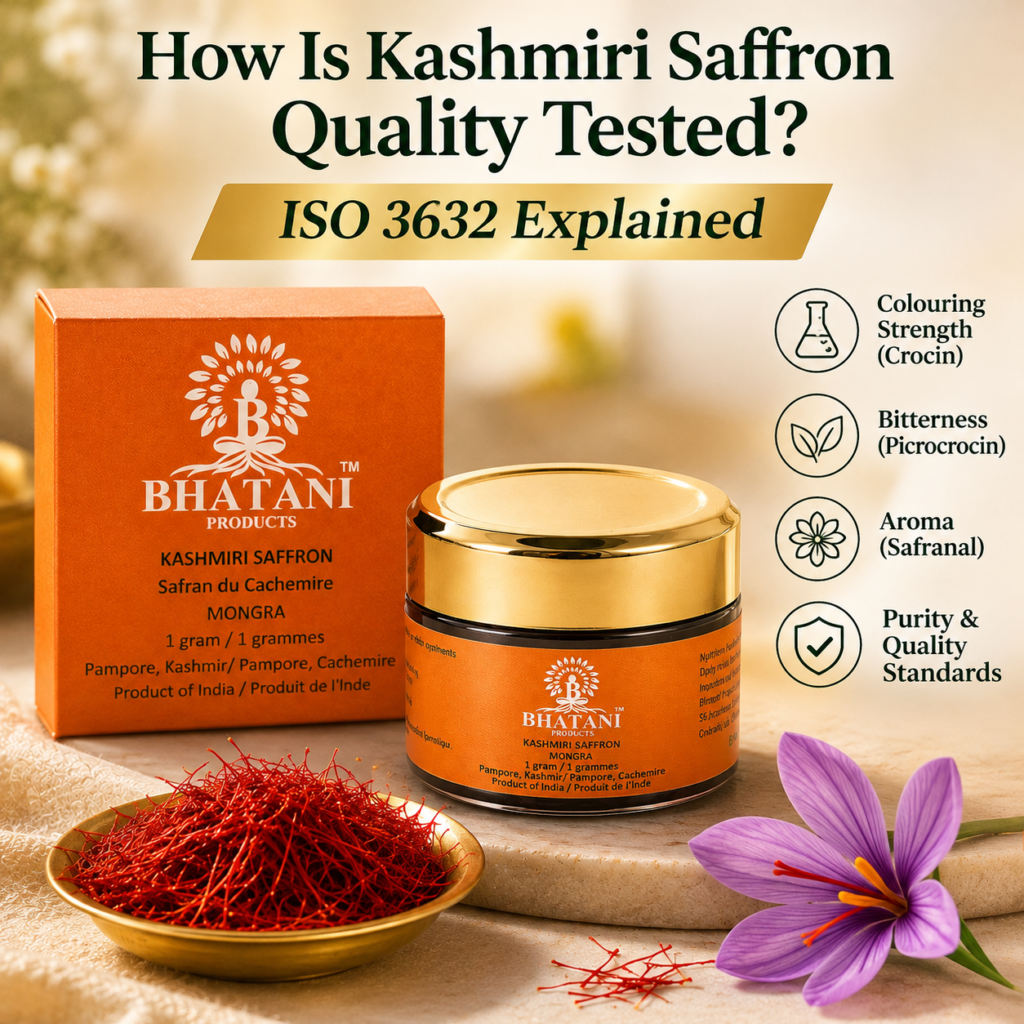
What makes one gram of Kashmiri saffron different from another? Is a higher price proof of better quality? And what do the numbers on a saffron laboratory report actually mean? For Canadians purchasing premium saffron, understanding how Kashmiri saffron quality is tested is more useful than relying on colour, packaging or marketing promises.
Saffron is among the world’s most labour-intensive spices. Every flower of Crocus sativus produces three stigmas that must be carefully harvested and dried. But where saffron comes from is only one part of its quality story. Processing, moisture, storage, foreign material and analytical characteristics all matter.
“The true value of saffron is not simply in its colour or price. It is in what can be understood, measured and verified.”
What Is ISO 3632 for Saffron?
ISO 3632 is an international standard for saffron specifications and testing methods. It provides a structured way to assess the characteristics of dried saffron, including its colouring strength, bitterness-related compounds, aroma-related measurements and other quality parameters.
The standard helps buyers and laboratories discuss saffron quality using defined measurements rather than subjective descriptions such as “super premium” or “the world’s finest.”
ISO 3632 is different from ISO 9001, which concerns quality management systems, and ISO 22000, which concerns food safety management systems. A management-system certificate does not establish the laboratory grade of an individual saffron batch.
What Do Laboratories Measure in Saffron?
Three measurements are particularly important when discussing saffron’s characteristic colour, flavour and aroma.
Crocin and Colouring Strength
Crocins are water-soluble pigments associated with saffron’s distinctive yellow-orange colour. Laboratories assess colouring strength using an absorbance measurement at approximately 440 nm. A higher properly measured value generally indicates greater colouring strength.
Picrocrocin
Picrocrocin contributes to saffron’s characteristic bitter taste. The relevant laboratory measurement is commonly associated with absorbance at approximately 257 nm. It helps describe a quality characteristic, rather than proving purity on its own.
Safranal
Safranal is an important aroma compound formed during saffron processing and storage. The standard includes an aroma-related absorbance measurement around 330 nm. This value should not be confused with a direct measurement of pure safranal content.
What Does ISO 3632 Category I Mean?
ISO 3632 uses quality categories based on defined analytical and physical requirements. Category I represents the highest category under the applicable classification system.
For example, a colouring-strength value of 200 is commonly associated with the minimum Category I colouring-strength requirement. However, an overall category cannot be assigned from colouring strength alone.
Moisture, ash, foreign matter, other analytical measurements, the test method and the edition of the standard must also be considered. A supplier’s use of the term “Grade A+” is not automatically equivalent to ISO Category I.
Before Accepting a Saffron Grade, Ask:
- Does the report identify the applicable ISO 3632 edition and test method?
- Does it identify the tested batch or lot?
- Does it include colouring strength, picrocrocin and aroma-related measurements?
- Are moisture, ash and foreign-matter results included?
- Is the overall category explicitly supported by the laboratory’s findings?
Why Does Moisture Matter in Kashmiri Saffron?
Moisture is an important consideration in dried saffron. Excessive moisture can affect shelf stability, product weight and storage quality. The moisture-and-volatile-matter measurement is therefore part of saffron quality assessment.
A laboratory result should be interpreted against the relevant specification, rather than treated as good or bad without context.
What Are Ash and Foreign-Matter Tests?
Total ash measures the inorganic residue remaining after a sample is incinerated under controlled laboratory conditions. Acid-insoluble ash can help indicate contamination from materials such as sand or soil.
Foreign-matter checks examine material that does not belong in the saffron sample. Together, these measurements provide information beyond the appearance of the red threads.
Does a Saffron Report Also Test for Mould?
Not necessarily. Saffron grading and microbiological testing answer different questions.
ISO 3632 Assessment
Examines defined physical and analytical characteristics of saffron, including colouring strength and other grading requirements.
Yeast and Mould Testing
Uses specified microbiological methods to measure or detect relevant organisms. A report should identify the method, result and applicable acceptance criteria.
A statement such as “moulds and insects: nil” may describe an inspection finding. It should not automatically be interpreted as a comprehensive microbiological test unless the report documents that testing.
Can You Confirm Saffron Purity at Home?
Looking at the threads, observing colour release in water and noticing saffron’s aroma can help a consumer identify suspicious products. But home checks have important limitations.
Genuine saffron can vary with its harvest, processing and storage conditions. Some adulterants are also difficult to identify without specialized analysis. No single home test establishes an official laboratory grade.
For a practical introduction to common authenticity clues, read our guide to identifying pure saffron .
What Makes Kashmiri Saffron Distinctive?
Kashmir has a longstanding saffron-growing heritage, with Pampore particularly associated with cultivation. Its regional identity reflects agricultural traditions, local growing conditions and generations of harvesting knowledge.
Origin matters to customers who value provenance, but geographical origin should not be used as a substitute for batch-specific quality evidence. Saffron from any region can vary between harvests and suppliers.
What Should Canadian Saffron Buyers Look For?
A Practical Saffron Buying Checklist
- Clear origin: Look for meaningful information about where the saffron was grown.
- Whole threads: Intact stigmas are easier to inspect than unidentified powders.
- Appropriate packaging: Choose packaging that protects the threads from moisture, light and heat.
- Traceability: Batch identification can help connect products with relevant records.
- Specific testing: Ask which quality or safety parameters have actually been assessed.
- Honest grading: Treat unsupported superlatives with caution.
The Bhatani Approach: Heritage and Transparency
At Bhatani Products, our interest in Kashmiri saffron goes beyond its appearance. We believe customers should understand the difference between origin, grading, analytical testing and food safety.
Supplier documentation can provide useful information about a shipment. However, individual reports must be evaluated according to their actual parameters, methods and batch details. We do not believe a marketing label should replace that evidence.
“Heritage gives a product its story. Transparency helps customers understand what they are buying.”
Discover Bhatani Kashmiri Saffron
Explore our Kashmiri saffron collection and bring a thoughtfully chosen botanical ingredient into your everyday culinary rituals.
EXPLORE OUR SAFFRONFrequently Asked Questions
What is ISO 3632 saffron testing?
It is a standardized approach to evaluating saffron specifications and laboratory measurements, including colouring strength, bitterness-related characteristics, aroma-related characteristics and other quality requirements.
Does ISO 3632 prove saffron is authentic?
ISO 3632 testing provides important quality information, but authenticity depends on the tests performed. Additional methods may be necessary to investigate particular adulterants.
Is Grade A+ the same as ISO Category I?
No. Grade A+ may be a commercial description. ISO Category I is associated with defined requirements under the relevant standard.
Is Kashmiri saffron always Category I?
No. Geographical origin does not automatically establish an ISO grade. Individual batches must be evaluated using the appropriate methods.
What does saffron colouring strength mean?
It describes the colouring performance measured under defined laboratory conditions. It is associated with saffron’s crocin pigments.
Can a mould report establish saffron quality?
A mould or microbiological report addresses particular safety or contamination parameters. It does not independently establish an ISO 3632 quality category.
Why is saffron expensive?
Each flower produces only three stigmas, and harvesting and processing require substantial manual labour. Price can also reflect sourcing, packaging and distribution. Price alone is not proof of quality.
How should saffron be stored?
Keep saffron in a tightly closed container in a cool, dry, dark place, away from moisture, direct sunlight and strong odours.
Further Reading and References
- International Organization for Standardization: ISO 3632 saffron standards
- PubMed: Research on saffron quality and ISO 3632
- PubMed: Saffron authentication and adulteration research
Final Thoughts
Understanding saffron quality means looking beyond the colour of its threads or the promises on a box. Laboratory measurements, grading requirements, origin, storage and traceability each tell a different part of the story.
For Canadian customers choosing Kashmiri saffron, the most useful question is not simply whether a product is described as premium. It is what evidence supports that description.
Educational Disclaimer: This article is provided for general information about saffron quality, laboratory testing and international grading standards. It does not certify or assign an ISO 3632 category to any specific Bhatani product or shipment. Laboratory results must be interpreted in accordance with the applicable methods and specifications.