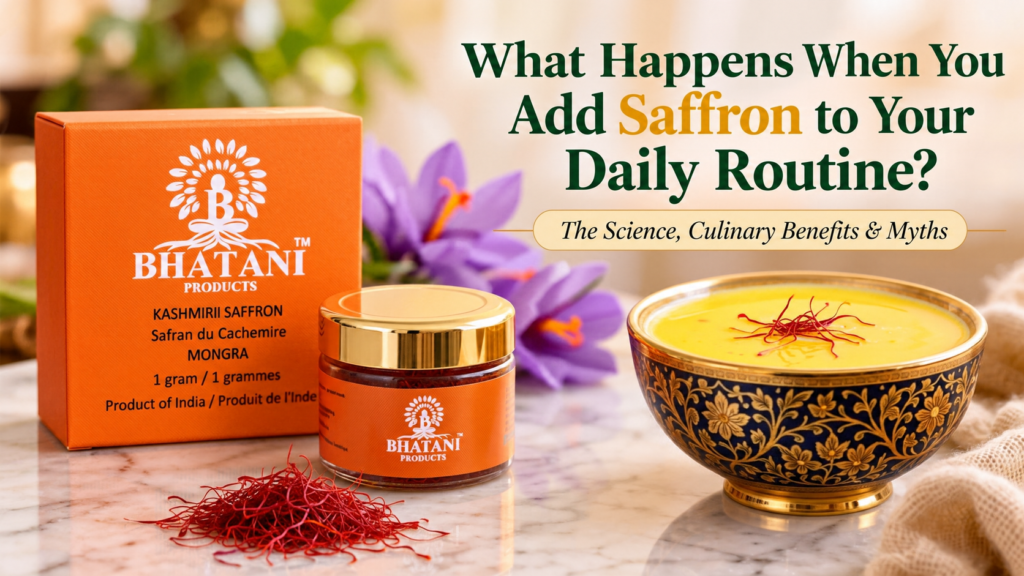
Curious about adding saffron daily to your routine? From warm saffron milk to aromatic Kashmiri Kesar tea, this distinctive spice has been part of culinary traditions for generations. But what does science actually tell us about saffron’s natural compounds, everyday uses and safety? This guide explores seven important facts to help Canadians make informed choices.
Saffron is one of the world’s most distinctive culinary ingredients. A few crimson threads can introduce golden colour, a delicate aroma and a complex flavour to food and beverages.
Researchers are also studying naturally occurring compounds in saffron. However, there is an important difference between enjoying saffron in food and consuming concentrated saffron extracts used in scientific studies.
At Bhatani Products, we believe understanding that difference is essential. An ingredient can be appreciated for its heritage, flavour and scientific interest without making exaggerated promises about its effects.
A meaningful daily ritual does not need extraordinary promises. Sometimes its value lies in the preparation, the flavour and the moment itself.
1. What Is Kashmiri Saffron?
Saffron comes from the dried stigmas of the Crocus sativus flower. Each flower produces three red stigmas that are carefully harvested and dried to create saffron threads.
Known as Kesar in many South Asian households, saffron has a long history in cooking, hospitality and cultural traditions.
Kashmiri saffron is associated with the Kashmir region of India, particularly the saffron-growing area around Pampore.
Its reputation reflects its distinctive culinary character, growing heritage and labour-intensive harvesting process.
However, geographic origin alone does not guarantee every aspect of quality. Harvesting, drying, handling, storage and authenticity also influence the finished product.
To understand what to look for before purchasing, read our guide to identifying pure saffron .
2. What Natural Compounds Are Found in Saffron?
Saffron contains naturally occurring compounds that contribute to its colour, aroma and flavour. Several have also attracted scientific interest.
Crocin
Crocins are water-soluble carotenoid compounds that contribute to saffron’s characteristic golden-yellow colouring.
Picrocrocin
Picrocrocin contributes to saffron’s characteristic bitter taste and plays an important role in its flavour profile.
Safranal
Safranal is an important volatile compound associated with saffron’s distinctive aroma. Processing and storage can influence its characteristics.
Crocetin
Crocetin is a carotenoid-related compound investigated in scientific research. Laboratory findings do not automatically establish health benefits in humans.
These compounds help explain why saffron is interesting from both culinary and scientific perspectives.
A published scientific review discusses saffron’s phytochemistry and quality control. You can explore the research on saffron’s natural compounds .
Does saffron’s antioxidant chemistry prevent disease?
Not necessarily. Researchers can observe antioxidant activity in laboratory experiments, but these findings do not prove that eating saffron prevents disease or produces particular medical outcomes.
Laboratory studies, animal research and human clinical trials answer different questions. Their findings should not be treated as interchangeable evidence.
3. What Does Science Say About Saffron and Wellness?
Scientific interest in saffron extends beyond its traditional culinary applications. Researchers have examined saffron preparations in studies involving mood, sleep and other health-related outcomes.
However, many studies use standardized extracts or measured preparations rather than ordinary saffron threads added to food.
What about saffron and mood?
Some clinical studies have examined saffron preparations in relation to mood-related outcomes. These findings are an area of scientific interest, not proof that drinking saffron tea treats depression or anxiety.
Results can differ depending on the preparation, amount, study duration, participant characteristics and research methods.
Saffron should never replace prescribed treatment or professional mental health care.
What about saffron and sleep?
Sleep-related outcomes have been investigated in studies involving certain saffron preparations. However, findings from concentrated extracts cannot automatically be applied to ordinary saffron milk or tea.
A warm beverage may be an enjoyable part of an evening routine. That personal experience is different from demonstrating a medicinal effect.
What about inflammation and heart health?
Researchers have investigated saffron compounds in relation to several biological processes. However, the available evidence does not justify promising that culinary saffron prevents cardiovascular disease, controls diabetes or treats inflammatory conditions.
These claims require condition-specific evidence from well-designed human studies and appropriate regulatory authorization.
For additional scientific context, explore this review of saffron chemistry and biological research .
Promising research deserves attention. It does not deserve exaggeration.
4. Is Saffron Milk the Same as a Saffron Supplement?
No. This distinction is especially important when interpreting scientific research.
Saffron threads used in cooking are a culinary ingredient. Standardized extracts may contain measured or concentrated amounts of particular constituents.
Whole Saffron Threads
Used in milk, tea, rice and desserts. Quantities vary by recipe, and their primary purpose is flavour, colour and aroma.
Standardized Extracts
Prepared and measured for particular formulations or research protocols. Their composition and intended use may differ from culinary saffron.
A few saffron threads in warm milk cannot be assumed to reproduce the exposure or outcomes of a clinical study involving a standardized extract.
Understanding this distinction helps consumers interpret health-related marketing more critically.
5. How Can You Enjoy Saffron Daily?
If you enjoy saffron’s flavour and aroma, there are several simple ways to incorporate it into your culinary routine.
You do not need an elaborate preparation. Start with a recipe you already enjoy and use a modest culinary quantity.
Option A: Warm Saffron Milk
Saffron milk, often called Kesar Doodh, is a familiar beverage in many South Asian households.
- Warm approximately one cup of milk or a preferred alternative.
- Add a small culinary pinch of saffron threads.
- Allow the saffron to steep for several minutes.
- Stir gently and adjust the flavour to your preference.
- Enjoy as part of a meal or personal routine.
The liquid gradually develops colour as saffron’s water-soluble pigments disperse through the drink.
Option B: Saffron Tea
Place a small culinary pinch of saffron threads in hot water and allow them to steep.
Depending on your preferences, you can experiment with cardamom, cinnamon or lemon.
Think of saffron tea as an aromatic beverage rather than a treatment for a medical condition.
Option C: Saffron Rice
Steep saffron in a little warm water, then incorporate the liquid into rice during cooking.
Saffron adds distinctive colour and aroma to dishes such as pulao, biryani and other celebratory recipes.
Option D: Desserts
Saffron can be used in kheer, custards, puddings, cakes and other desserts.
Its flavour is distinctive, so a small amount can often go a long way.
Explore Saffron Through Seven Culinary Ideas
- Day 1: Prepare warm saffron milk.
- Day 2: Try a light saffron infusion.
- Day 3: Add saffron to rice.
- Day 4: Pair saffron with cardamom.
- Day 5: Make a saffron-flavoured dessert.
- Day 6: Revisit your favourite recipe.
- Day 7: Choose the preparation you enjoy most.
These are culinary ideas, not a therapeutic dosing schedule. There is no need to consume saffron every day.
6. Is It Safe to Use Saffron Every Day?
Saffron has a long history of culinary use, but ordinary food quantities and concentrated medicinal preparations should not be confused.
Safety depends on factors such as the quantity consumed, preparation, individual circumstances and potential medication interactions.
Saffron is not free from possible side effects simply because it comes from a plant.
Who should seek professional advice?
If you are pregnant or breastfeeding, take prescription medications, have a medical condition or are considering concentrated saffron supplements, consult a qualified healthcare professional.
In particular, people taking anticoagulant or antiplatelet medication should not assume medicinal saffron preparations are free from interactions.
Is more saffron better?
No. Increasing the amount does not necessarily improve a recipe, and consuming large quantities may introduce safety concerns.
Use modest culinary quantities, follow relevant product directions and avoid self-prescribing saffron to treat medical conditions.
7. How Do You Choose Quality Saffron in Canada?
Whether you enjoy saffron occasionally or incorporate it into a regular cooking routine, product quality and transparency matter.
Look for clearly identified ingredients, net quantity, origin information and appropriate storage guidance.
Before Buying Kashmiri Kesar, Ask:
- Form: Is the product sold as whole threads or powder?
- Origin: Does the seller clearly explain the stated origin?
- Quantity: Is the net weight displayed?
- Quality: Are grading and testing claims supported?
- Transparency: Can customers contact the seller?
- Storage: Are handling instructions available?
International specifications such as ISO 3632-1:2025 address defined characteristics of dried saffron.
However, a product should not be described as independently certified or verified unless there is evidence supporting that specific claim.
You can also explore Bhatani Products for more information about our wellness collection and educational resources.
How Should You Store Kashmiri Saffron?
Saffron’s flavour, aroma and colour can be affected by storage conditions.
Keep dried saffron in a tightly closed container, away from excessive heat, moisture and direct sunlight.
Avoid leaving the container open near steam while cooking, and use clean, dry utensils when handling the threads.
Always follow any storage instructions supplied on the product packaging.
Why Bhatani Values Thoughtful Everyday Rituals
At Bhatani Products, we believe that meaningful routines are often simple.
Preparing a warm drink, cooking a favourite meal or sharing food with family can create moments worth repeating.
Kashmiri Kesar reflects this philosophy through its culinary heritage, distinctive character and the care involved in producing it.
Our goal is to help customers understand the ingredients they choose and make informed decisions.
Quality deserves attention. Trust deserves transparency. Everyday rituals deserve care.
Discover Bhatani Kashmiri Saffron
Explore the distinctive flavour, aroma and culinary heritage of Kashmiri Kesar. Discover thoughtful ways to enjoy saffron in everyday food and drinks.
EXPLORE COLLECTIONFrequently Asked Questions About Saffron
What happens if you drink saffron milk every day?
You may enjoy its aroma, colour and flavour as part of your culinary routine. There is insufficient evidence to promise specific health outcomes from ordinary saffron milk consumption.
Is saffron tea good for sleep?
Certain saffron preparations have been studied in relation to sleep. However, research involving extracts does not establish that culinary saffron tea treats insomnia.
What are the benefits of saffron in food?
Saffron contributes distinctive colour, aroma and flavour to food. It also contains compounds of scientific interest, but medical benefits should not be assumed from culinary consumption.
Can saffron improve mood?
Some clinical studies have examined standardized saffron preparations and mood-related outcomes. Their findings cannot be directly applied to ordinary saffron threads used in recipes.
Can I add saffron to hot milk?
Yes. Saffron is commonly steeped in warm milk or incorporated into cooked dishes. Follow your preferred recipe and use culinary quantities.
How many saffron threads should I use?
Culinary quantities depend on the recipe, serving size and desired flavour. Use modest recipe amounts rather than treating thread counts as medical doses.
Is Kashmiri Kesar different from regular saffron?
Kashmiri Kesar refers to saffron associated with Kashmir. Saffron from different growing regions comes from the same botanical species, although growing and processing conditions can influence its characteristics.
Is saffron safe during pregnancy?
Culinary use and concentrated medicinal quantities should not be confused. Consult a qualified healthcare professional before using saffron supplements during pregnancy or breastfeeding.
Final Thoughts: A More Thoughtful Saffron Routine
Adding saffron to your daily routine can be a simple way to explore distinctive flavours and reconnect with familiar culinary traditions.
Its natural compounds have attracted scientific interest, but research should always be interpreted in context.
A few saffron threads used in cooking are not equivalent to a standardized extract used in a clinical study.
Whether you enjoy Kashmiri Kesar in warm milk, tea, rice or desserts, choose quality ingredients and maintain realistic expectations.
A good ritual does not need a miracle attached to it.
Research and Further Reading
- Saffron Phytochemistry, Quality Control and Medicinal Uses: Updated Review
- Saffron Chemistry, Biological Activities and Toxicity: Scientific Review
- ISO 3632-1:2025 Saffron Specification
Educational Disclaimer: This article provides general information about saffron as a culinary ingredient. It is not medical advice and does not establish therapeutic benefits for Bhatani Kashmiri Saffron. Research on concentrated extracts should not be interpreted as evidence of equivalent effects from culinary saffron use. Consult a qualified healthcare professional regarding medical conditions, medications, pregnancy, breastfeeding or supplement use.