
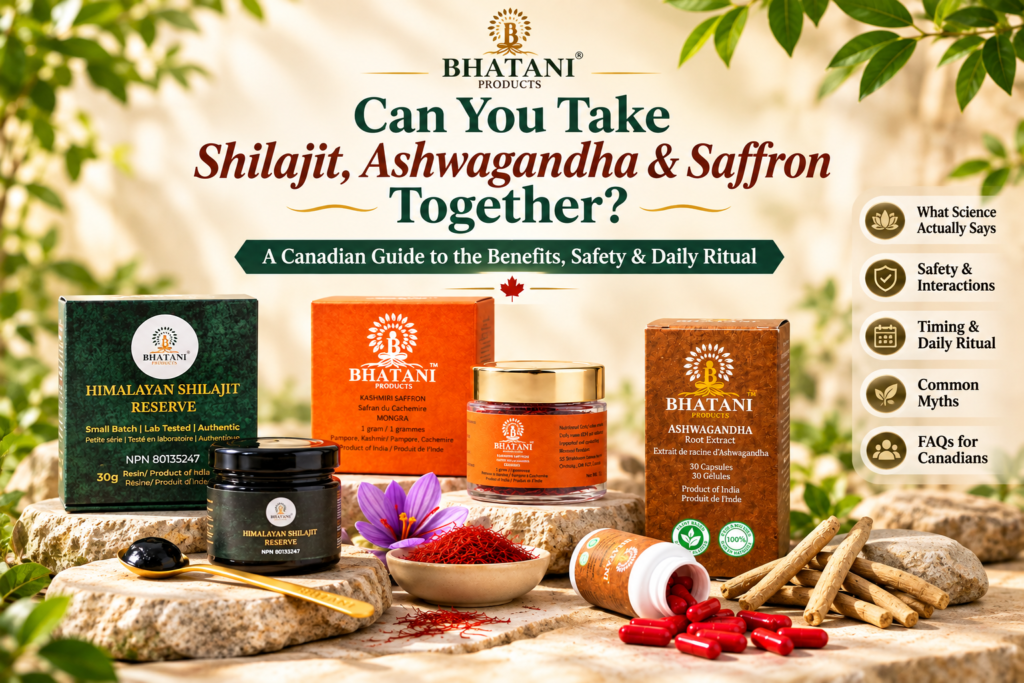
Shilajit Ashwagandha Saffron — can these three natural health products be taken together? This Canadian guide examines what scientific research tells us about their individual uses, possible interactions, safety considerations and how to approach a daily wellness routine without unsupported health claims.
Picture an ordinary Canadian morning. The kettle is on, the day is already filling with responsibilities, and somewhere between breakfast and the first meeting, you wonder whether your wellness routine could be a little more intentional.
Perhaps you have heard about Shilajit. Perhaps Ashwagandha keeps appearing in conversations about stress and sleep. Maybe you already enjoy Saffron in your cooking and have noticed growing interest in its scientific research.
Eventually, a natural question emerges: If people are interested in all three, would taking them together make sense?
The answer is more interesting than the confident promises sometimes found online.
Quick answer: There is insufficient high-quality human research to establish the safety, ideal dosage or additional benefits of combining Shilajit, Ashwagandha and Saffron. Research involving each ingredient separately cannot establish that taking all three together is beneficial or suitable for everyone.
That uncertainty does not mean every combination is necessarily harmful. It means the decision deserves more thought than simply adding another supplement to your shopping basket.
This guide explores the research, common misconceptions, possible interactions and practical questions Canadians should consider before combining these ingredients.
Why Are People Combining Shilajit, Ashwagandha and Saffron?
Modern wellness routines can become surprisingly complicated.
A person might begin by researching one ingredient. Then a video recommends another. A friend mentions a third. Soon, what started as a simple interest becomes a collection of bottles, capsules, powders and conflicting instructions.
The attraction of these three ingredients is understandable. Each has a different history, composition and body of research.
The Resin
A complex natural substance containing organic compounds and minerals. Researchers have investigated selected Shilajit preparations in relatively small human studies.
The Root
A botanical ingredient investigated in clinical trials involving perceived stress, anxiety-related measures and sleep outcomes.
The Stigma
A valued culinary ingredient whose concentrated preparations have been examined in clinical studies involving mood-related outcomes.
Yet these differences do not establish that the ingredients complement one another biologically.
“Different ingredients do not automatically create a better combination. Sometimes the most valuable part of a wellness ritual is understanding what you truly need.”
Shilajit Ashwagandha Saffron: What Does Research Say?
Although Shilajit, Ashwagandha and Saffron have each been studied individually, high-quality clinical research evaluating all three together is lacking. Their combined safety and effectiveness should not be assumed.
Before discussing combinations, we need to distinguish three kinds of information: research findings, plausible scientific theories and marketing promises.
A laboratory experiment may suggest how a compound behaves under controlled conditions. A small human trial may report a particular outcome. A large review may identify patterns across several studies.
These are not interchangeable levels of evidence.
1. Ashwagandha: What Human Studies Have Examined
Ashwagandha, or Withania somnifera, is one of the more frequently studied botanical ingredients in discussions about stress and sleep.
Several randomized trials have investigated Ashwagandha preparations in adults. Some reported improvements in perceived stress or sleep-related measures.
However, an important detail is often overlooked: the studies did not all use the same preparation.
Different trials have used different extracts, amounts, durations and participant groups. That makes it difficult to translate the results into a universal recommendation.
The US National Institutes of Health also identifies potential concerns, including drowsiness, digestive symptoms, thyroid effects, medication interactions and rare reports of liver injury.
Independent research: NIH — Ashwagandha Research, Evidence and Safety .
What This Means for Readers
Some Ashwagandha preparations have produced encouraging findings in selected studies. This does not prove that every Ashwagandha product has the same effects, or that combining it with other ingredients improves those outcomes.
2. Shilajit: Why the Specific Preparation Matters
Shilajit is often described online with sweeping promises about energy, stamina, hormones and performance.
Scientific research offers a more limited picture.
One randomized, double-blind, placebo-controlled study examined a particular purified Shilajit preparation in men aged 45 to 55. The researchers reported changes in selected hormone measurements after 90 days.
This was a specific study involving a specific preparation and population. It does not establish the same effects for every Shilajit resin or every adult.
It also does not demonstrate that Shilajit works better when combined with Ashwagandha or Saffron.
Independent research: Clinical Evaluation of Purified Shilajit — Randomized Human Trial .
If you would like to understand the ingredient itself in greater detail, our separate article on how Shilajit is made explores its preparation without repeating that discussion here.
3. Saffron: From the Kitchen to Clinical Research
Saffron occupies a distinctive place in this conversation.
For many families, it is already familiar through food: rice, desserts, warm milk and recipes shared across generations.
Scientific research, however, often examines Saffron in a very different form from the few threads used in cooking.
A 2026 systematic review and meta-analysis examined 34 randomized controlled trials involving 1,769 participants.
The researchers reported improvements in certain self-reported depression and anxiety measures. Other measures, including some clinician-rated outcomes, did not show statistically significant improvements.
The authors called for further high-quality research.
That distinction matters. Evidence involving a standardized Saffron extract cannot automatically be applied to culinary Saffron threads.
Independent research: Saffron and Mood-Related Outcomes: 2026 Systematic Review .
The Most Important Question: Does Combining Them Create Synergy?
The word synergy sounds compelling.
In scientific terms, however, synergy is not simply another way of saying that two or more ingredients are consumed together.
To establish a meaningful synergistic effect, researchers need evidence showing that a combination produces an interaction beyond what would be expected from its individual components.
That requires appropriate study designs, measured outcomes and suitable comparison groups.
At present, there is insufficient high-quality clinical evidence establishing that taking Shilajit, Ashwagandha and Saffron together produces such an effect.
Individual Research Exists
Certain preparations have been studied separately in humans, with findings that depend on the study design and outcomes.
The Combined Effect
A clinically established benefit, ideal dose, timing schedule or safety profile for the three-ingredient combination has not been demonstrated.
This does not make the subject uninteresting. Quite the opposite: it reveals an important question that deserves better research.
Can Taking Three Supplements Increase the Risk of Side Effects?
Potentially, yes.
Each additional ingredient introduces another set of considerations: dosage, formulation, medical history, medication use and individual tolerance.
Combining products also makes it harder to identify which ingredient may be responsible if an unwanted effect occurs.
Medication Interactions
Ashwagandha may interact with certain medications, including sedatives, thyroid hormones, blood pressure medicines, diabetes medicines and immunosuppressants.
People using antidepressants, anticoagulants or other prescription medicines should also seek professional advice before adding concentrated botanical products. The potential concern depends on the particular medication and preparation.
The absence of a published interaction study is not proof that a combination is free from interactions.
Pregnancy and Breastfeeding
Pregnancy and breastfeeding require particular caution.
Ashwagandha is not recommended during pregnancy or breastfeeding by the US National Center for Complementary and Integrative Health.
Concentrated Saffron products and Shilajit supplements should not be added to a pregnancy or breastfeeding routine without appropriate medical advice.
Ordinary culinary use of a spice should not be confused with concentrated supplemental dosing.
Existing Health Conditions
People with thyroid conditions, autoimmune disorders, liver concerns or other ongoing medical conditions should seek individual guidance before combining products.
Shilajit users should also follow product-specific cautions concerning kidney conditions, gout and related medical history.
Safety reference: NCCIH — Ashwagandha: Usefulness and Safety .
Morning, Afternoon or Evening: Does Timing Matter?
Search online and you may find a familiar formula:
Shilajit in the morning. Saffron in the afternoon. Ashwagandha before bed.
It sounds organized. It also makes a complicated subject appear remarkably simple.
But there is no established clinical evidence that this particular three-part schedule is superior or universally safe.
Some individuals may prefer particular times for practical reasons, such as following product directions, taking a product with food when appropriate, or avoiding activities when drowsiness occurs.
These preferences are not evidence of a scientifically optimized combination.
Three Rules Worth Remembering
- Follow each product label. Do not substitute an online schedule for the directions supplied with the product.
- Spacing is not a safety guarantee. Taking supplements hours apart does not necessarily eliminate interactions.
- There is no universal combination dose. Do not combine amounts from unrelated clinical trials to invent a daily regimen.
What If You Are Already Taking One of Them?
Imagine someone who already uses one wellness product and is considering adding another.
The useful first question is not simply, “What should I add?”
It is, “Why am I considering a change?”
Perhaps a social media video made an impressive claim. Perhaps a friend described a positive personal experience. Perhaps a new product looked appealing.
Those experiences may inspire curiosity, but they do not replace evidence or individual safety assessment.
Before adding another product, review your current medications, existing health conditions, label directions and reasons for considering the change.
A pharmacist or qualified healthcare professional can help identify potential interactions and whether an additional supplement is appropriate.
Five Common Myths About Combining Natural Ingredients
Natural Means Risk-Free
Natural substances can have biological effects, side effects and medication interactions.
More Ingredients Mean Better Results
Adding ingredients does not establish additional benefits and may introduce unnecessary complexity.
Different Timing Prevents Interactions
Some interactions may persist beyond the time a supplement is taken. Spacing is not a universal solution.
Every Product Matches the Studies
Clinical trials use specific preparations, doses and populations. Findings cannot be transferred automatically to every retail product.
A Daily Ritual Requires Supplements
Hydration, balanced meals, movement and adequate sleep can form a meaningful routine without requiring multiple supplements.
The Bhatani Approach: A Ritual That Fits Your Life
Canadian seasons have a way of changing our routines.
A bright summer morning feels different from a dark winter evening. Work schedules shift. Family commitments change. Some days are carefully planned; others unfold unexpectedly.
A sustainable wellness ritual should make room for real life.
At Bhatani, we believe the starting point is not a complicated supplement schedule. It is a series of manageable choices that can be repeated.
Make Space for Yourself
Drink water, enjoy a nourishing breakfast when appropriate and identify one realistic priority for the day.
Find a Moment to Reset
Step away from the screen, move your body and make time for a meal without unnecessary distractions.
Give Rest Its Place
Establish a consistent bedtime, reduce distractions and create a calmer environment for sleep.
Some people may choose to include an appropriate wellness product as part of their routine.
That decision should be guided by the individual product label, relevant safety considerations and professional advice when needed.
“You don’t need a perfect day. Just a few moments worth repeating.”
A Simple Seven-Day Ritual Reflection
Before changing your supplement routine, consider spending a week observing your everyday habits.
This is not a clinical assessment or a way to measure supplement effectiveness. It is simply an opportunity to reflect.
Seven Questions for Seven Days
- Day 1: Am I making enough time for regular meals?
- Day 2: How consistent is my sleep schedule?
- Day 3: Have I made time for movement?
- Day 4: Am I staying hydrated throughout the day?
- Day 5: What habits make my routine harder to maintain?
- Day 6: Am I relying on online claims rather than reliable information?
- Day 7: What is one small habit I would like to continue?
This kind of reflection may help you decide which questions are worth discussing with a healthcare professional before considering additional products.
Five Questions to Ask Before Combining Supplements
If you are considering Shilajit, Ashwagandha and Saffron together, these questions are more useful than a generic online schedule.
1. What Is My Reason for Considering Each Ingredient?
Be specific about what interests you. Avoid assuming that an ingredient is necessary simply because it appears in a popular wellness routine.
2. Am I Taking Prescription or Over-the-Counter Medication?
Share a complete list of medicines and supplements with your pharmacist or healthcare professional.
3. Have I Read the Individual Labels?
Different products can have different directions, warnings and intended uses. A general article cannot replace product-specific instructions.
4. Am I Expecting Results That Research Has Not Established?
Be cautious about claims involving guaranteed energy, hormonal changes, mood improvement or superior results from combining ingredients.
5. Would a Simpler Routine Be More Appropriate?
A wellness routine should fit your circumstances rather than create unnecessary obligations.
Where the Bhatani Heritage Bundle Fits
Bhatani Products brings together three distinctive ingredients in the Heritage Bundle:
- Himalayan Shilajit Resin 30g
- Kashmiri Saffron 3g
- Ashwagandha Capsules — 60 Count
Each product has its own identity and individual directions.
The collection is designed to bring these Bhatani products together for convenient exploration. It is not presented as a clinically tested three-ingredient formula or a universal daily dosing regimen.
There is no requirement to consume all three products together.
We encourage customers to read each label, consider individual health circumstances and seek professional guidance before combining supplements.
Three Distinct Ingredients. One Thoughtful Collection.
Discover Himalayan Shilajit Resin, Kashmiri Saffron and Ashwagandha from Bhatani Products. Explore each ingredient, review its product information and choose what belongs in your personal wellness journey.
EXPLORE THE COLLECTIONFrequently Asked Questions
Can you take Shilajit, Ashwagandha and Saffron together?
There is insufficient high-quality human research establishing the safety or additional benefits of taking all three together. Individual medical circumstances, medications and product directions should be reviewed before combining supplements.
Can I take Shilajit and Ashwagandha on the same day?
There is no universally established schedule for this combination. Whether both are appropriate depends on the preparations, your medical history and possible interactions.
Can I take Ashwagandha and Saffron together?
Research involving these ingredients individually does not establish a safe or effective combined regimen. Consult a qualified healthcare professional before using concentrated preparations together.
Can Shilajit and Saffron be mixed in warm water?
Mixing ingredients physically is not the same as establishing the safety or benefits of consuming them together. Follow individual product directions and do not assume a combined drink is more effective.
Is it better to take Shilajit in the morning?
There is no universally proven best time for every Shilajit product or user. Follow the directions supplied with your particular product.
Should Ashwagandha always be taken before bed?
No. Research has not established a universal bedtime schedule for every Ashwagandha preparation. Follow the label and consider possible drowsiness or medication interactions.
Is Saffron tea the same as a Saffron extract?
No. Clinical research often uses measured or standardized extracts. Culinary Saffron infusions cannot automatically be expected to produce the same outcomes.
Can I take all three supplements every day?
There is no established universal daily regimen for this combination. Long-term safety data are limited, and individual product directions and health considerations matter.
Will combining the three improve energy, sleep and mood?
Such combined benefits have not been established in high-quality human clinical research. Findings involving individual preparations should not be treated as proof of combined effects.
Does the Bhatani Heritage Bundle have a recommended combination schedule?
The Heritage Bundle is a collection of individual products, not a clinically validated combination regimen. Follow each product’s directions and seek professional guidance before combining them.
Scientific References & Further Reading
The sources below discuss research and safety considerations involving individual ingredients. They do not establish the effectiveness or safety of the Bhatani Heritage Bundle as a combined regimen.
- NIH Office of Dietary Supplements: Ashwagandha Research and Safety
- NCCIH: Ashwagandha Usefulness and Safety
- Clinical Evaluation of Purified Shilajit in Healthy Volunteers
- Saffron and Mood-Related Outcomes: Systematic Review and Meta-analysis
Final Thoughts: A Better Question Than “Can I Take More?”
Shilajit, Ashwagandha and Saffron each have their own history, characteristics and research questions.
But the most useful wellness decisions are not necessarily the most complicated.
Instead of asking how many ingredients can fit into one routine, consider what you understand about each one, whether it is appropriate for you, and how it fits alongside the everyday habits that matter.
Science continues to investigate these ingredients. Until stronger combination research becomes available, thoughtful choices are more valuable than confident promises.
At Bhatani Products, we believe customer education should come before the sale.
Your Ritual. Your Choice. Our Commitment.
Heritage Refined.
Educational Disclaimer: This article provides general educational information and is not medical advice, diagnosis or treatment. Research discussed here may involve preparations, dosages and populations different from Bhatani products. No combined clinical benefit or safety outcome is claimed for the Heritage Bundle. Follow all individual product directions, contraindications and warnings. Consult a qualified healthcare professional before combining supplements, especially if pregnant, breastfeeding, taking medication or managing a medical condition. Do not discontinue prescribed treatment based on this article.