
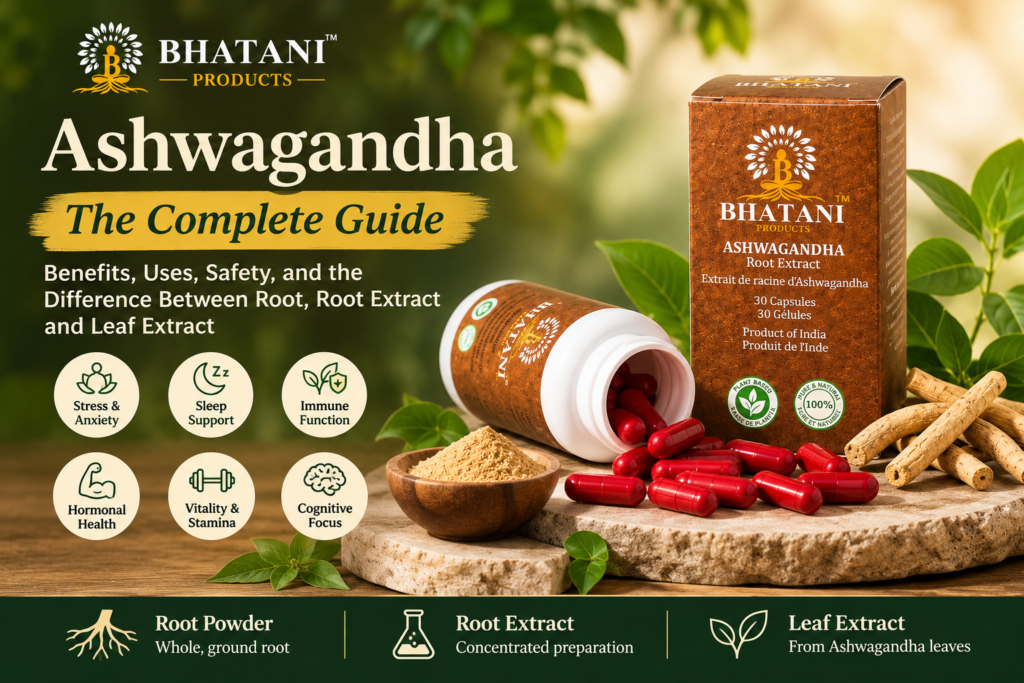
What does Ashwagandha do to your body? This complete Canadian guide explores 10 important questions about Ashwagandha, including stress, sleep, cortisol, testosterone, immune function, side effects, and the differences between root powder, root extract, and leaf extract.
Ashwagandha (Withania somnifera) has become one of the most widely discussed botanical ingredients in the wellness world. From social media to scientific journals, it is associated with an extraordinary range of claims.
But scientific interest is not the same as scientific proof. Some short-term human studies have reported encouraging findings involving perceived stress and certain sleep measurements. Other proposed effects remain uncertain, and long-term safety has not been adequately established.
This comprehensive educational guide answers ten important questions about Ashwagandha, explains the differences between plant parts and preparations, and examines the evidence, limitations, and safety considerations that Canadian readers should understand.
What You’ll Learn
- What Ashwagandha is and how it is studied.
- What research says about stress and anxiety symptoms.
- Whether morning or evening use makes a difference.
- Potential side effects and medication interactions.
- How long Ashwagandha studies typically last.
- What scientists have found about sleep and cortisol.
- What is known about testosterone and immune function.
- The difference between root powder, root extract, leaf extract, and root-and-leaf extract.
- How to evaluate Ashwagandha information and product licensing in Canada.
What Is Ashwagandha?
Ashwagandha is a shrub whose roots have a long history of use in traditional Ayurvedic and Unani practices. It is sometimes called Indian ginseng or winter cherry, although it is not botanically related to true ginseng.
Modern Ashwagandha preparations may contain dried root powder, concentrated root extract, leaf extract, or combinations of plant parts.
These preparations can differ substantially in chemical composition. Factors such as plant material, growing conditions, harvesting, storage, and extraction methods can influence the final preparation.
What Are Withanolides?
Withanolides are naturally occurring compounds found in Ashwagandha. Researchers investigate them because they may contribute to some of the plant’s biological activities.
However, withanolide concentration alone does not establish the effectiveness or safety of a particular preparation.
What Does Adaptogen Mean?
Ashwagandha is frequently described as an adaptogen, a term used for substances proposed to influence the body’s response to stress.
The term does not mean that a botanical automatically restores hormonal balance, strengthens immunity, or produces the same results in every person.
1. What Does Ashwagandha Do to Your Body?
Researchers have investigated Ashwagandha in relation to the body’s stress-response system, sleep, selected hormone measurements, and immune-related laboratory markers.
Some human studies have reported differences between participants receiving particular Ashwagandha extracts and those receiving a placebo.
However, changes in research measurements do not necessarily establish meaningful health benefits, and findings from one preparation cannot automatically be applied to another.
Stress
Several short-term trials have examined perceived stress and related questionnaire scores.
Sleep
Some trials have investigated sleep quality, duration, and efficiency.
Hormones
Researchers have investigated cortisol and selected reproductive hormone measurements.
Immune Protection
Evidence does not establish that Ashwagandha prevents infections or reliably improves immune protection.
2. Does Ashwagandha Help With Stress and Anxiety?
Stress is among the more extensively investigated areas of Ashwagandha research.
A review summarized by the US National Institutes of Health examined seven studies involving 491 adults. Several studies reported improvements in perceived stress or anxiety-related questionnaire scores compared with placebo.
These findings are scientifically interesting, but the trials differed in their preparations, populations, and methods.
Does This Mean Ashwagandha Treats Anxiety Disorders?
No such broad conclusion can be drawn from the available evidence.
Everyday stress, anxiety symptoms, and diagnosed anxiety disorders are different circumstances. Research involving one population cannot automatically establish effectiveness in another.
Persistent anxiety symptoms should be assessed by a qualified healthcare professional. Botanical supplements should not replace prescribed treatment or psychological care.
For further information, consult the NIH Office of Dietary Supplements research summary.
3. Should You Take Ashwagandha in the Morning or at Night?
Research has not established a universally superior time of day for Ashwagandha.
Clinical trials have used different schedules, and there is insufficient evidence to conclude that morning use is consistently better for stress or evening use is consistently better for sleep.
Daytime Routine
Some people prefer taking supplements with breakfast when the particular product’s directions permit it.
Nighttime Routine
Others prefer evening use, although timing alone does not establish a sleep-related benefit.
Anyone using a licensed Ashwagandha product should follow its authorized directions and cautions rather than changing the schedule based on general internet advice.
Drowsiness is a possible side effect, so caution is appropriate with activities requiring alertness.
4. What Are the Side Effects of Ashwagandha?
Natural origin does not guarantee that a botanical is free of adverse effects.
Some commonly reported effects associated with Ashwagandha preparations include:
- Nausea or stomach discomfort.
- Loose stools or diarrhea.
- Drowsiness.
- Occasional vomiting.
Can Ashwagandha Affect the Liver?
Rare cases of liver injury have been associated with Ashwagandha-containing supplements.
Some reports involve multi-ingredient products, making causation difficult to establish in every case. Nevertheless, these reports are important safety information.
Symptoms such as yellowing of the eyes or skin, dark urine, unusual itching, or significant abdominal discomfort require prompt medical attention.
Can Ashwagandha Affect the Thyroid?
Some clinical observations and case reports suggest that Ashwagandha may influence thyroid hormone measurements.
Individuals with thyroid disorders or those taking thyroid medications should consult a qualified healthcare professional before considering Ashwagandha.
5. How Long Does Ashwagandha Take to Work?
There is no established timeline that applies to every individual or every Ashwagandha preparation.
Many clinical trials investigating stress or sleep have measured outcomes after several weeks, commonly around six to eight weeks.
These are research observation periods, not promises that a person will experience a noticeable change within a particular number of days.
Understanding Research Timelines
- Immediate effects: Reliable immediate benefits have not been established.
- Several weeks: Many trials assess outcomes after repeated use.
- Six to eight weeks: A common duration in some stress and sleep studies.
- Long-term use: Safety and effectiveness over many months or years remain insufficiently understood.
Do not increase a supplement’s serving amount simply because a particular effect has not been noticed.
6. Can Ashwagandha Help You Sleep?
Sleep is another area of scientific interest.
Researchers have investigated sleep quality, total sleep time, sleep efficiency, and the time required to fall asleep.
A systematic review of five randomized trials involving 372 adults reported a small overall improvement in certain sleep outcomes with Ashwagandha preparations compared with placebo.
However, the studies were relatively short, and their findings cannot be generalized to all products or populations.
Does Ashwagandha Make Everyone Sleepy?
No. Drowsiness is a possible side effect, but individual responses vary.
What Else Matters for Sleep?
Consistent sleep schedules, regular physical activity, appropriate caffeine habits, and a comfortable sleeping environment remain important considerations.
Persistent insomnia or other sleep difficulties should be discussed with a healthcare professional.
7. Does Ashwagandha Lower Cortisol?
Cortisol is a hormone involved in metabolism, immune signalling, blood pressure regulation, and the body’s normal response to stress.
It is sometimes called the stress hormone, but cortisol is essential for normal physiological functioning.
Some Ashwagandha studies have reported lower cortisol measurements compared with placebo.
However, cortisol naturally changes throughout the day. A single measurement cannot describe a person’s overall stress response or establish that a supplement has corrected a medical problem.
Is Lower Cortisol Always Better?
No. Healthy cortisol regulation is important, and excessively low cortisol can also be harmful.
Claims that Ashwagandha permanently resets cortisol, restores adrenal function, or corrects hormonal imbalance go beyond what the available evidence establishes.
Understanding the body’s natural processes is more useful than assuming that every hormone should be increased or decreased.
8. Is Ashwagandha Safe to Take Every Day?
Daily Ashwagandha use has been investigated in studies lasting several weeks and, in some cases, approximately three months.
Some preparations appear reasonably well tolerated during short-term use in the populations studied. However, long-term safety remains uncertain.
Who Should Avoid Ashwagandha or Seek Medical Advice?
Important Safety Considerations
- Pregnancy: Avoid Ashwagandha during pregnancy.
- Breastfeeding: Avoid use because reliable safety information is insufficient.
- Thyroid disorders: Potential thyroid-related effects require professional assessment.
- Autoimmune conditions: Seek specialist guidance because of possible immune-related effects and medication interactions.
- Liver conditions: Discuss the reported liver-injury concerns with a healthcare professional.
- Hormone-sensitive prostate cancer: Avoid use unless specifically advised by the treating specialist.
- Upcoming surgery: Inform the surgical team about all supplements being taken.
- Prescription medications: Potential interactions should be assessed before use.
Which Medications May Interact With Ashwagandha?
Potential interactions have been identified with sedatives, thyroid medications, immunosuppressants, blood pressure medications, and diabetes medications.
This is not an exhaustive list. A pharmacist or qualified healthcare professional can assess the relevance of these concerns to an individual’s circumstances.
9. Does Ashwagandha Boost Testosterone?
Testosterone-related claims are common in supplement advertising, particularly in products marketed to men.
Some small studies have investigated testosterone measurements and selected reproductive-health outcomes among specific groups of participants.
The evidence does not establish that Ashwagandha reliably increases testosterone in every man or treats clinically diagnosed testosterone deficiency.
Does Ashwagandha Improve Fertility?
Preliminary studies have examined certain reproductive-health measurements, including sperm parameters.
These findings do not establish Ashwagandha as a treatment for infertility.
What About Hormonal Effects in Women?
Research remains limited. Ashwagandha should not be described as a universal hormone-balancing ingredient for women or men.
Anyone experiencing hormonal or reproductive-health concerns should seek an appropriate medical evaluation.
10. Does Ashwagandha Boost Your Immune System?
Immune-system claims require particular care because laboratory findings are sometimes presented as though they demonstrate clinical benefits.
The immune system is a complex network of cells, tissues, and signalling processes. Increased immune activity is not automatically beneficial.
What Have Researchers Investigated?
Laboratory and animal studies have investigated Ashwagandha compounds in relation to inflammatory signalling and immune-cell activity.
Some preliminary human studies have examined selected immune markers.
However, changes in laboratory markers do not establish that Ashwagandha prevents infections or provides meaningful immune protection.
Can Ashwagandha Prevent Colds or Flu?
There is insufficient reliable human evidence to establish Ashwagandha as a method of preventing colds, influenza, COVID-19, or other infectious diseases.
What About Autoimmune Conditions?
People with autoimmune disorders should be cautious because of possible immune-related effects and interactions with immunosuppressive treatments.
Ashwagandha should not be used to manage an autoimmune condition without appropriate medical guidance.
What Matters for Everyday Immune Health?
Adequate sleep, nutritious food, regular physical activity, appropriate vaccination, and medical care remain important.
Ashwagandha should not be presented as a substitute for these measures.
Ashwagandha Root vs Root Extract vs Leaf Extract: What’s the Difference?
Not all Ashwagandha supplements are made from the same part of the plant. Some contain whole root powder, others contain concentrated root extract, while certain formulations use leaves or combinations of roots and leaves.
Although these preparations may all be described as Ashwagandha, they are not necessarily interchangeable.
The plant part, extraction process, concentration, and chemical composition can influence how a preparation is evaluated.
1. Ashwagandha Whole Root Powder
Whole root powder is produced by drying and grinding Ashwagandha roots.
Unlike a concentrated extract, it generally retains the broad composition of the dried root material.
Its composition may vary according to growing conditions, harvesting, storage, and processing.
Important distinction: A serving of whole root powder cannot automatically be compared milligram-for-milligram with a concentrated extract.
2. Ashwagandha Root Extract
Root extract is produced by extracting selected constituents from Ashwagandha roots through a defined manufacturing process.
Some extracts are standardized to specified concentrations of withanolides or other marker compounds.
Standardization helps characterize a preparation, but it does not automatically establish greater effectiveness or safety.
Many human studies have investigated particular standardized Ashwagandha extracts. Their findings apply most directly to the formulations actually studied.
Important distinction: Two root extracts produced using different methods may have different chemical profiles and should not automatically be considered equivalent.
3. Ashwagandha Leaf Extract
Ashwagandha leaves also contain naturally occurring compounds, including withanolides.
However, their chemical composition can differ from that of the roots.
For example, the concentration of certain constituents, including withaferin A, may differ between plant parts and preparations.
Withaferin A has attracted scientific interest in laboratory research, but its presence does not establish a particular clinical benefit.
Research findings from root-based preparations should not automatically be applied to leaf extracts.
Important distinction: Leaf extract is not inherently unsafe simply because it comes from leaves. Its safety and effectiveness depend on the particular preparation, composition, and intended use.
4. Ashwagandha Root-and-Leaf Extract
Some preparations contain extracts made from both roots and leaves.
The proportions of plant material and the extraction process can influence the final chemical composition.
A root-and-leaf extract should not automatically be considered equivalent to a root-only extract, even if both preparations list similar amounts or withanolide percentages.
Comparing the Four Ashwagandha Preparations
Root Powder
Plant part: Root
Processing: Dried and ground
Consideration: Not directly equivalent to concentrated extracts.
Extracted Root
Plant part: Root
Processing: Extraction, sometimes with standardization
Consideration: Evidence depends on the particular extract studied.
Extracted Leaves
Plant part: Leaves
Processing: Extraction
Consideration: Composition and evidence may differ from root preparations.
Combined Extract
Plant parts: Roots and leaves
Processing: Combined extraction or blending
Consideration: Cannot automatically be treated as equivalent to root-only extracts.
Does a Higher Withanolide Percentage Mean Better Ashwagandha?
Ashwagandha products sometimes advertise different withanolide percentages.
These figures may help describe a formulation, but they should not be interpreted as a universal measure of quality, effectiveness, or safety.
Different testing methods may measure different groups of compounds. Preparations with similar reported percentages may still have different chemical profiles.
A higher percentage does not automatically mean stronger clinical effects or fewer side effects.
What Should You Look For?
- Botanical identity: Is the ingredient identified as Withania somnifera?
- Plant part: Root, leaf, or root-and-leaf?
- Preparation: Whole powder or extract?
- Standardization: Are relevant marker compounds identified?
- Serving details: Is the amount clearly stated?
- Safety: Are warnings and contraindications provided?
- Canadian licensing: Is the specific natural health product authorized for sale in Canada?
Is Root Extract Better Than Leaf Extract?
There is no universal answer.
Root-only preparations have a substantial history of traditional use and have been investigated in numerous modern studies.
Leaf-based and combined preparations have different chemical profiles and require their own evaluation.
Consumers should not assume that one preparation is automatically more effective or safer solely because of the plant part or an advertised withanolide percentage.
The important question is not simply how much Ashwagandha is in a capsule. It is what preparation the capsule contains and what evidence applies to that preparation.
How Much Ashwagandha Should You Take?
There is no single amount appropriate for every individual or every formulation.
Clinical studies have used different preparations and research protocols. These should not be treated as personalized dosage recommendations.
When considering a licensed natural health product, follow its authorized directions and warnings.
Consult a qualified healthcare professional if you are uncertain whether a product is suitable for you.
How to Evaluate Ashwagandha Information in Canada
Canadian consumers should distinguish between general scientific information and claims authorized for a specific natural health product.
Questions Worth Asking Before Choosing a Product
- What plant part was studied? Root, leaf, or a combination?
- Was it powder or extract? These preparations may differ substantially.
- Who participated? Were the study participants relevant to the intended audience?
- How long was the study? Short-term results do not establish long-term safety.
- What was measured? A laboratory marker, questionnaire score, or clinically meaningful outcome?
- Was the study controlled? Randomized placebo-controlled studies generally provide stronger evidence than testimonials.
- Is the product licensed? In Canada, verify the specific natural health product and its authorized conditions of use.
What Does an NPN Mean?
A Natural Product Number (NPN) identifies a natural health product licensed by Health Canada.
Licensing relates to the specific product, its ingredients, authorized uses, and conditions of use.
An NPN does not establish that every claim made about an ingredient online is authorized for that particular product.
Consumers can consult the Health Canada Licensed Natural Health Products Database for product-specific information.
Can Ashwagandha Be Combined With Shilajit or Saffron?
Ashwagandha, Shilajit, and saffron are different ingredients with distinct compositions, research histories, and safety considerations.
Findings from studies of an individual ingredient do not establish that combining it with other supplements will provide additional benefits.
Combining supplements may also complicate medication interactions or make it harder to identify the cause of an adverse reaction.
Anyone considering multiple supplements should review the directions and cautions for each product and seek professional guidance when appropriate.
What About Daily Wellness Habits?
A thoughtful wellness routine does not need to revolve around a single supplement.
Regular meals, hydration, physical activity, adequate sleep, and time for relaxation are meaningful everyday habits.
Supplements should not be viewed as substitutes for these habits or for necessary medical care.
Understanding an ingredient is just as important as deciding whether it belongs in your routine.
Why Bhatani Products Prioritizes Botanical Education
At Bhatani Products, we believe that botanical education should include both scientific findings and scientific uncertainty.
Ashwagandha has a long history of traditional use and an expanding body of research. It also has unanswered questions about formulation differences, long-term safety, and how findings from individual studies apply to the wider population.
This article discusses Ashwagandha as a botanical ingredient. It does not describe the authorized uses of any Bhatani Ashwagandha product or establish the effectiveness or regulatory approval of a particular commercial preparation.
Our Commitment to Informed Choices
Bhatani Products believes responsible botanical education begins with reliable information, an understanding of research limitations, and awareness of potential risks.
We encourage readers to consult reputable scientific resources and qualified healthcare professionals when making decisions about supplements.
Frequently Asked Questions About Ashwagandha
What does Ashwagandha do to your body?
Human research has investigated perceived stress, sleep, cortisol, and selected other measurements. Findings vary by formulation and study population.
Does Ashwagandha work immediately?
Reliable immediate benefits have not been established. Many studies measure outcomes over several weeks.
Should you take Ashwagandha in the morning or at night?
There is no universally established best time. Follow the directions for the specific licensed product being considered.
Can Ashwagandha make you sleepy?
Yes. Drowsiness is a reported side effect, although individual responses vary.
Does Ashwagandha help with anxiety?
Some clinical trials have investigated anxiety-related symptoms, but the evidence does not establish Ashwagandha as a replacement for established treatment of anxiety disorders.
Does Ashwagandha lower cortisol?
Some studies have reported lower cortisol measurements. However, cortisol is essential for normal functioning, and lowering it is not always desirable.
Can Ashwagandha help with sleep?
Some studies have reported modest improvements in certain sleep measures. These findings do not establish that every Ashwagandha product treats insomnia.
Does Ashwagandha increase testosterone?
Limited studies have reported changes in testosterone measurements among selected participants. It is not established as a treatment for testosterone deficiency.
Does Ashwagandha boost immunity?
Evidence is insufficient to establish that Ashwagandha prevents infections or reliably improves immune protection.
Is Ashwagandha safe to take every day?
Daily use has been studied for relatively short periods, but long-term safety remains uncertain. Individual health circumstances and product-specific warnings matter.
Can Ashwagandha affect the thyroid?
Some research and case reports suggest possible thyroid effects. Individuals with thyroid conditions should seek professional advice.
Can Ashwagandha cause liver problems?
Rare cases of liver injury have been associated with Ashwagandha-containing supplements. Symptoms suggesting liver injury require prompt medical assessment.
Can Ashwagandha be used during pregnancy?
Ashwagandha should be avoided during pregnancy. Use during breastfeeding is also discouraged because of insufficient reliable safety information.
What is the difference between Ashwagandha root extract and leaf extract?
Root and leaf extracts are produced from different plant parts and may have different chemical profiles. Research findings from one preparation should not automatically be applied to another.
Is a higher withanolide percentage always better?
No. A higher reported percentage does not automatically establish better effectiveness, quality, or safety.
Should Ashwagandha be cycled?
No universally established evidence-based cycling schedule exists. Long-term use should not be assumed safe simply because a botanical has a history of traditional use.
Is Ashwagandha legal in Canada?
Ashwagandha may be included in licensed natural health products in Canada. The licensing status and authorized uses of a particular product should be verified through Health Canada’s database.
Final Thoughts: What Should You Know About Ashwagandha?
Ashwagandha is a botanical with a long history of traditional use and an expanding body of scientific research.
Some short-term human studies have reported encouraging findings involving perceived stress and sleep. Research involving cortisol, testosterone, and immune-related processes continues, but broad claims should not be made without adequate evidence.
The differences between whole root powder, root extract, leaf extract, and combined preparations also matter. Not all Ashwagandha products contain the same material, and findings from one formulation cannot automatically be generalized to another.
Safety is equally important. Possible side effects, medication interactions, and unanswered questions about long-term use deserve attention.
For Canadian readers, understanding the distinction between scientific research and a particular product’s authorized uses is an important part of making informed decisions.
Heritage deserves respect. Science deserves accuracy. Your wellness decisions deserve both.
Scientific Research and Trusted Resources
The following resources provide additional information about Ashwagandha research, safety, and natural health product licensing.
- NIH Office of Dietary Supplements — Ashwagandha: Health Professional Fact Sheet
- NIH Office of Dietary Supplements — Ashwagandha: Consumer Fact Sheet
- NIH National Center for Complementary and Integrative Health — Ashwagandha
- Health Canada — Licensed Natural Health Products Database
Educational Disclaimer: This article provides general educational information and is not medical advice, diagnosis, or treatment. It discusses Ashwagandha as a botanical ingredient, not the authorized uses, safety, effectiveness, or regulatory status of a specific Bhatani Ashwagandha product. Findings from studies of particular preparations cannot automatically be generalized to other products. Consult a qualified healthcare professional before using Ashwagandha, particularly if you take medication, have an existing medical condition, or are preparing for surgery. Avoid use during pregnancy and breastfeeding. Do not discontinue prescribed treatment or use supplements as a substitute for appropriate medical care.