
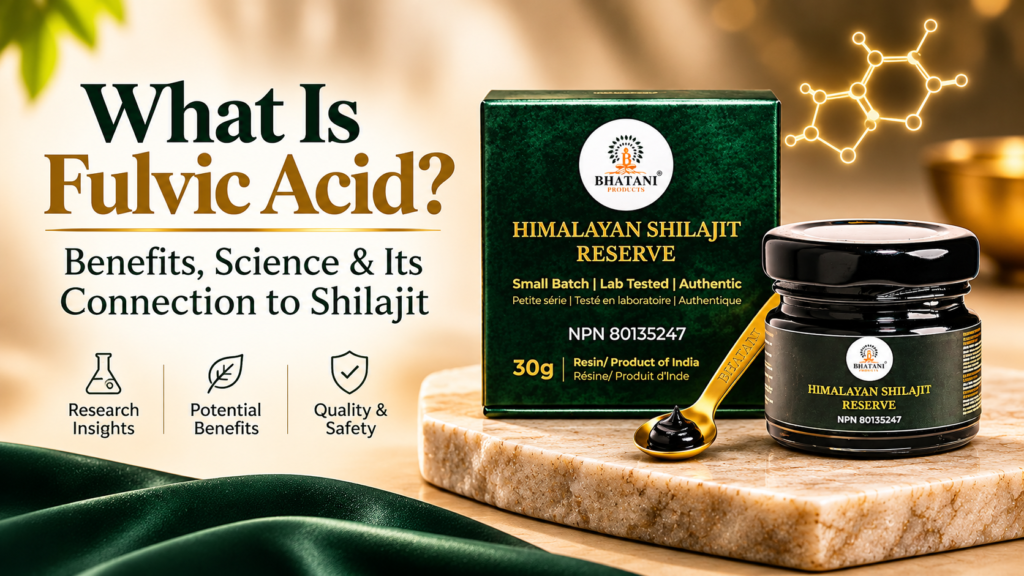
What is fulvic acid? Explore its potential benefits, safety, scientific research, and connection to Shilajit in this educational guide for Canadians.
If you’ve searched for fulvic acid benefits, you’ve probably encountered claims about energy, gut health, mineral absorption, and healthy aging. Some of these ideas have scientific origins, but important questions remain about how laboratory findings translate into real benefits for humans.
This guide explores what fulvic acid actually is, what researchers have discovered, its relationship with Shilajit, and how to distinguish meaningful product quality from impressive-sounding marketing.
What Is Fulvic Acid?
Fulvic acid refers to a complex group of naturally occurring organic substances formed through the breakdown and transformation of organic matter. It belongs to the broader family of compounds known as humic substances.
These substances occur in environments such as soil, peat, and natural water systems. They are produced through biological and chemical processes involving organic material and microorganisms.
Unlike vitamin C or magnesium, fulvic acid is not one precisely defined molecule. Its composition can vary depending on the source, environmental conditions, extraction process, and laboratory measurement method.
This distinction matters when evaluating supplements. Two products advertised as containing fulvic acid may not contain chemically identical preparations.
Where Does Fulvic Acid Come From?
Soil & Organic Matter
Fulvic substances develop as organic material undergoes natural decomposition and transformation in soil and other environments.
Water & Peat
Fulvic substances may occur in natural waters and organic deposits, where they participate in complex environmental chemical processes.
Mineral-Organic Material
Shilajit is a complex natural substance that may contain fulvic substances alongside other organic and inorganic constituents.
What Are the Potential Benefits of Fulvic Acid?
Researchers have investigated fulvic substances for several interesting chemical and biological properties. However, most proposed health benefits remain supported primarily by laboratory studies, animal research, or limited human evidence.
Understanding this difference is essential. A substance showing activity in a laboratory does not automatically mean that taking it as a supplement produces the same effect in the human body.
1. Antioxidant Properties
Certain fulvic substances have demonstrated antioxidant-related activity under experimental conditions. Researchers have investigated their interactions with reactive chemical species associated with oxidation.
However, these findings do not establish that fulvic acid supplementation prevents oxidative damage or improves health outcomes in humans.
2. Mineral Interactions
One of the most interesting characteristics of fulvic substances is their ability to interact with certain mineral ions.
This property is well recognized in environmental chemistry. It helps explain why fulvic substances are studied in relation to mineral movement and availability in natural systems.
Claims that fulvic acid dramatically improves mineral absorption in humans, however, require stronger clinical evidence.
3. Inflammation Research
Some experimental studies have explored whether particular fulvic preparations influence biological processes associated with inflammation.
Although these observations are scientifically interesting, they are not sufficient to establish fulvic acid as a treatment for inflammatory diseases.
4. Gut Health
Fulvic and related humic substances have attracted interest for their possible interactions with digestive and biological systems.
Nevertheless, high-quality human research remains insufficient to confirm that fulvic acid supplements improve digestion, balance the gut microbiome, or treat gastrointestinal conditions.
5. Energy and Cellular Function
Shilajit preparations have been investigated in research involving cellular processes and energy-related biological mechanisms.
But Shilajit is a complex mixture, and findings from studies of whole Shilajit preparations cannot automatically be attributed to fulvic acid alone.
Claims that isolated fulvic acid increases energy, reverses aging, or enhances mitochondrial function in humans remain inadequately established.
Scientific curiosity is valuable. But the difference between promising research and proven human benefits is what makes informed wellness decisions possible.
For additional independent medical context, explore Cleveland Clinic’s educational overview of fulvic acid.
Is Fulvic Acid the Same as Shilajit?
No. Although the terms are sometimes used interchangeably in supplement marketing, fulvic acid and Shilajit are not the same substance.
Fulvic acid refers to a group of organic compounds. Shilajit is a more complex mineral-organic material that can contain fulvic substances and numerous other constituents.
Fulvic Acid
A group of naturally occurring organic compounds found in multiple environmental sources. It may be extracted and studied separately.
Shilajit
A complex mineral-organic substance containing a mixture of compounds whose composition depends on source and processing.
Whole vs. Component
Research involving isolated fulvic acid does not automatically prove the effects of Shilajit, and research involving Shilajit does not isolate the effects of fulvic acid.
Does Higher Fulvic Acid Content Mean Better Shilajit?
When shopping for Shilajit in Canada, you may encounter advertisements promoting extremely high fulvic acid percentages.
Numbers such as 70%, 80%, or 90% can appear convincing, especially when presented alongside scientific terminology.
But here’s an important question: How was that percentage measured?
Fulvic acid is a chemically complex category of substances, and laboratory measurements can vary depending on the analytical method used.
A percentage alone cannot establish a product’s overall purity, safety, identity, or superiority.
What Should You Look for Instead?
Rather than relying exclusively on a headline percentage, consider whether the company provides meaningful product documentation, batch identification, and appropriate quality testing.
For more information about what product documentation can tell you, visit the Bhatani Certificates and Quality Standards page.
Is Fulvic Acid Safe? What Are the Side Effects?
Safety depends on the particular preparation, its concentration, purity, recommended dose, and the individual using it.
Because fulvic substances can come from different natural sources, products may vary considerably in their composition.
Important Safety Considerations
- Contamination: Poorly sourced or inadequately processed natural materials may contain unwanted contaminants.
- Digestive discomfort: Some preparations may cause gastrointestinal symptoms or other adverse reactions.
- Medication interactions: Reliable information about possible interactions remains limited.
- Product variability: Different formulations and extraction methods can produce different chemical compositions.
- Individual medical considerations: People with existing medical conditions may require additional precautions.
Pregnant or breastfeeding individuals, people taking medications, and those with underlying medical conditions should consult a qualified healthcare professional before considering supplements.
Always follow the directions, warnings, and contraindications on the specific product label.
How Can Canadians Choose Quality Shilajit?
When buying Shilajit, the most useful questions often have little to do with dramatic advertising.
Instead, ask whether the product is appropriately licensed, whether its quality documentation is available, and whether the company provides clear information about what is inside the jar.
5 Things to Check Before Buying Shilajit in Canada
- Health Canada NPN: Look for a Natural Product Number and verify the product through the Licensed Natural Health Products Database.
- Third-Party Testing: Look for relevant independent laboratory documentation rather than relying solely on marketing claims.
- Batch Traceability: Check whether the product has an identifiable batch number and expiry date.
- Clear Product Information: Read the recommended use, ingredients, warnings, origin, and other relevant label information.
- Accessible Documentation: Consider whether the brand provides information supporting its quality and transparency statements.
What Makes Bhatani Shilajit Different?
At Bhatani Products, our philosophy begins with a straightforward belief: customers should understand what they are purchasing.
Bhatani Himalayan Shilajit Resin 30g carries Health Canada NPN 80135247.
Our quality approach emphasizes third-party laboratory testing, batch traceability, clear product labeling, and accessible documentation.
We offer Shilajit in resin format, with a focus on responsible product information rather than exaggerated ingredient claims.
Our approach to wellness also emphasizes consistency, balanced habits, and informed personal choices.
Discover more about our products and quality philosophy at Bhatani Products Canada.
Know What’s Inside. Understand What Matters.
Explore Bhatani Himalayan Shilajit Resin, our commitment to quality documentation, and the details behind every jar. Because trust begins with transparency.
EXPLORE COLLECTIONWhat Does Science Still Need to Discover?
Despite growing interest in fulvic acid, several important research questions remain unanswered.
Scientists still need more rigorous human studies to better understand how different fulvic preparations behave after ingestion, whether particular formulations provide measurable benefits, and how long-term safety varies by source and dose.
Research must also account for the fact that fulvic acid is not a single standardized molecule.
These uncertainties are not reasons to dismiss scientific investigation. They are reasons to interpret findings carefully and avoid presenting preliminary results as established medical facts.
Frequently Asked Questions
What does fulvic acid do for humans?
Fulvic acid has been studied for antioxidant-related properties, mineral interactions, and other biological activities. However, high-quality human evidence remains insufficient to establish many commonly advertised benefits.
Is fulvic acid good for your gut?
Research into fulvic substances and digestive health is preliminary. There is not enough reliable clinical evidence to conclude that fulvic acid supplements improve gut health or treat digestive disorders.
Does fulvic acid increase energy?
Evidence that isolated fulvic acid reliably increases energy in humans is limited. Studies involving whole Shilajit preparations cannot automatically establish the effects of fulvic acid alone.
Is fulvic acid the main ingredient in Shilajit?
Fulvic substances are among the constituents associated with Shilajit, but Shilajit is a complex mixture. Its composition varies according to the source, processing, and analytical methods used.
Is 80% fulvic acid Shilajit better?
Not necessarily. A high advertised percentage does not independently establish superior quality. The testing method, product identity, contaminant testing, and supporting documentation are also important.
Can fulvic acid remove heavy metals from the body?
Although fulvic substances can interact chemically with certain metals, this does not prove that consuming fulvic acid safely removes heavy metals from the human body. It should not be used as a substitute for medically supervised treatment of heavy-metal exposure.
Can I take fulvic acid every day?
There is no universal daily dosage recommendation for all fulvic acid preparations. Follow the directions of the specific licensed product and consult a healthcare professional when appropriate.
How do I know if Shilajit is approved in Canada?
Check the product label for an eight-digit Natural Product Number (NPN). You can verify the product’s licensing information through Health Canada’s Licensed Natural Health Products Database.
Final Thoughts: Look Beyond the Fulvic Acid Percentage
Fulvic acid is a fascinating subject in natural chemistry and Shilajit research. Its chemical properties continue to attract scientific interest, but many advertised health benefits remain uncertain.
For Canadian consumers, understanding the difference between scientific evidence and supplement marketing is an important part of making informed purchasing decisions.
The next time you see a Shilajit product promoting an extraordinary fulvic acid percentage, consider asking a different question:
A percentage tells you what a brand wants you to notice. Transparent documentation helps you understand what you’re actually buying.
At Bhatani, we believe informed choices, product transparency, and consistent daily habits deserve more attention than exaggerated promises.
Heritage Refined.
References & Further Reading
- Cleveland Clinic — Fulvic Acid: Uses, Research and Safety
- Health Canada — Licensed Natural Health Products Database
- Health Canada — About Natural Health Products
- Bhatani Products — Certificates and Quality Standards
Educational Disclaimer: This article is provided for general educational purposes only and is not intended as medical advice, diagnosis, or treatment. Research findings discussed here do not establish approved health claims for Bhatani products. Individual circumstances vary. Always follow the recommended use, warnings, and contraindications on the product label, and consult a qualified healthcare professional if you have questions about supplements or existing health conditions.