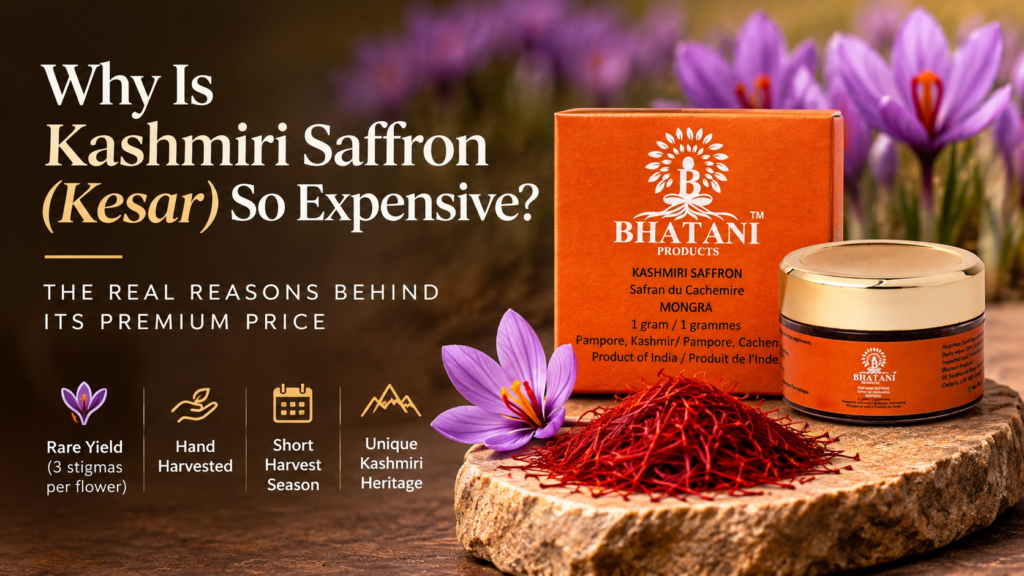
Why is Kashmiri saffron so expensive? Known as Kashmiri Kesar, this remarkable spice carries a story that begins long before its crimson threads reach a Canadian kitchen. Behind every gram are thousands of delicate flowers, skilled hands, a brief autumn harvest and generations of agricultural heritage.
Saffron is often described as one of the world’s most expensive spices. But what makes Kashmiri Kesar command a premium? Is it the rarity, the labour, its geographical origin or simply clever marketing?
At Bhatani Products, we believe customers should understand what they are paying for. This guide explores the real reasons behind Kashmiri saffron prices, from the fields of Pampore to the shelves of Canadian retailers.
What Is Kashmiri Kesar?
Kashmiri Kesar and Kashmiri saffron refer to the same spice. Kesar is a commonly used name for saffron in Hindi and several other South Asian languages. Kashmiri identifies its geographical origin.
Saffron comes from the flower of Crocus sativus, a plant that produces three red stigmas in each blossom. These stigmas are carefully collected, separated and dried to create the saffron threads used in cooking.
Kashmir’s saffron-growing heritage is closely associated with Pampore and surrounding areas, where the crop has been cultivated for generations. The region’s agricultural traditions form an important part of the story behind Kashmiri Kesar.
1. Why Does One Gram of Kashmiri Kesar Require So Much Work?
The first reason Kashmiri saffron is expensive is surprisingly simple: each flower produces very little usable spice.
Every saffron crocus produces just three red stigmas. After harvesting and drying, these become the delicate threads sold by the gram.
Estimates suggest that approximately 70,000 to 200,000 flowers may be required to produce one kilogram of dried saffron, depending on growing conditions and yield.
One Crocus Flower
Each flower produces only three harvestable red stigmas.
A Small Final Yield
Large numbers of blossoms are needed to produce relatively small amounts of dried Kashmiri Kesar.
Careful Separation
The delicate stigmas must be separated and handled carefully before drying.
This extraordinary flower-to-spice ratio helps explain why even a small jar of Kashmiri saffron represents substantial agricultural effort.
2. Why Is Kashmiri Saffron Harvested by Hand?
Imagine standing in a field of purple saffron crocuses during the autumn harvest in Pampore.
Workers gather the flowers during a relatively short seasonal window. The red stigmas are then separated from the blossoms, a process requiring care and patience.
Unlike many agricultural commodities that can be harvested mechanically at enormous scale, saffron production remains heavily dependent on manual labour.
Harvesting, stigma separation, drying and sorting all contribute to production costs.
“The value of Kashmiri Kesar is not measured only by its weight, but by the work behind every thread.”
The University of Vermont discusses the labour-intensive nature of saffron production and why it contributes to the spice’s high price.
3. Why Is the Kashmiri Kesar Harvest Season So Short?
Saffron crocuses typically flower in autumn, and growers must collect their blossoms during a limited harvesting period.
Farmers maintain their fields throughout the year, but the opportunity to harvest the flowers is concentrated into a comparatively short window.
Flowering and harvest timing depend on seasonal weather conditions. Unexpected rainfall or other disruptions can make an already demanding harvest more difficult.
Because saffron cannot simply be harvested continuously throughout the year, the seasonal nature of production contributes to supply constraints.
4. How Do Climate and Farming Conditions Affect Kashmiri Saffron Prices?
Kashmir’s saffron farmers face agricultural challenges that can affect both harvest quantities and production costs.
Changes in rainfall patterns, temperature and land use have raised concerns about the future of saffron cultivation in the region.
Reuters reported in January 2025 that saffron production in Kashmir had declined from approximately 8 metric tonnes in 2010–11 to 2.6 metric tonnes in 2023–24.
These figures illustrate the pressures affecting the industry. They do not, by themselves, establish current retail prices or predict future harvests.
Researchers and farmers have also explored alternative cultivation methods, including controlled-environment growing, as potential responses to changing agricultural conditions.
Read the Reuters report on Kashmir’s saffron cultivation challenges.
5. What Makes Kashmiri Kesar Different From Saffron Grown Elsewhere?
Genuine saffron comes from Crocus sativus, whether it is cultivated in Kashmir, Iran or another producing region.
Kashmiri Kesar is distinguished by its regional origin, cultivation heritage and cultural significance.
Kashmir Saffron received Geographical Indication (GI) registration in India in 2020, recognising its connection to the region.
This geographical recognition is important, but it should not be interpreted as proof that every product marketed as Kashmiri saffron has independently verified origin.
Customers interested in the official designation can consult the Indian Geographical Indications Registry .
6. Why Is Kashmiri Kesar Expensive in Canada?
The price of Kashmiri Kesar in Canada reflects more than what happens on the farm.
Once saffron has been harvested and dried, it must move through an international supply chain before reaching Canadian customers.
Depending on the supplier and distribution model, costs may include transportation, import handling, packaging, currency exchange, inventory and retail operations.
Growing and Harvesting
Cultivation, manual labour, stigma separation and drying.
International Distribution
Shipping, handling, supply-chain management and exchange-rate effects.
Packaging and Retail
Packaging, storage, customer service and business operating costs.
These expenses help explain why the retail price of Kashmiri saffron in Canada may differ substantially from prices quoted near its place of production.
However, a higher price does not automatically guarantee superior quality or authenticity.
7. Is Expensive Kashmiri Saffron Worth Buying?
The answer depends on how you intend to use it and what matters to you as a customer.
Kashmiri Kesar is often used in small quantities in recipes such as saffron rice, desserts, milk and tea.
Because only a small amount may be needed for a recipe, purchasing saffron by the gram can be practical.
Rather than judging value by the total package price alone, consider the price per gram, your intended use and how often you expect to prepare saffron-based dishes or beverages.
Before Buying Kashmiri Kesar in Canada
- Compare the price per gram: This makes different package sizes easier to evaluate.
- Consider how often you use it: Occasional users may prefer smaller quantities.
- Check the stated origin: Look for clear product information and transparent seller details.
- Plan for storage: Protect saffron from moisture, heat and light.
8. Should You Buy 1g, 3g or 5g of Kashmiri Kesar?
Choosing the right quantity can make purchasing premium saffron more practical.
For someone experimenting with saffron recipes, a 1g package may be a convenient starting point.
Households that regularly prepare saffron milk, rice dishes or desserts may prefer larger quantities.
Bhatani Products offers Kashmiri saffron in 1g, 3g and 5g options so customers can select a quantity that suits their needs.
Explore our Kashmiri saffron collection to see the available options.
9. Is Kashmiri Kesar the Same as Kashmiri Saffron?
Yes. Kashmiri Kesar and Kashmiri saffron are two names for the same spice from the Kashmir region.
Customers may encounter different terms when shopping online, including Kashmiri Kesar, Kashmir saffron, saffron threads and Kesar.
These terms can help describe a product, but names alone do not establish its authenticity or geographical origin.
For guidance on recognising genuine saffron, read our separate educational article: How to Identify Pure Saffron .
10. Why Bhatani Believes the Story Behind Kashmiri Kesar Matters
At Bhatani Products, we believe understanding the origins of a product is part of appreciating its value.
Kashmiri saffron represents agricultural heritage, patient craftsmanship and the work of growers whose livelihoods are connected to the land.
Its value is not simply about a premium price. It is about recognising the effort behind something used in such small quantities.
“Heritage is not simply where something comes from. It is the care we choose to preserve.”
Whether you add Kashmiri Kesar to a family recipe, prepare saffron milk or enjoy a quiet cup of tea, we believe the experience should begin with understanding and trust.
A Little Kesar. A Remarkable Story.
Discover Bhatani Kashmiri Saffron in 1g, 3g and 5g options. Choose the quantity that belongs in your kitchen and your everyday rituals.
EXPLORE BHATANI SAFFRONFrequently Asked Questions About Kashmiri Saffron and Kesar
Why is Kashmiri saffron so expensive?
Kashmiri saffron is expensive because each crocus produces only three stigmas, harvesting and separation require substantial manual labour, and production depends on a limited seasonal crop. Import and retail costs also influence prices in Canada.
Why is Kashmiri Kesar expensive in Canada?
Kashmiri Kesar carries agricultural production costs as well as expenses associated with international transportation, handling, packaging and retail distribution in Canada.
Is Kashmiri Kesar the same as Kashmiri saffron?
Yes. Kesar is another commonly used name for saffron. Kashmiri Kesar refers to saffron associated with the Kashmir region.
Is Kashmiri saffron more expensive than Iranian saffron?
It can be, but prices vary by supplier, harvest, quantity, packaging and market conditions. Origin alone does not determine quality or retail price.
How many flowers are needed to produce saffron?
Estimates suggest approximately 70,000 to 200,000 flowers may be needed for one kilogram of dried saffron, depending on growing conditions and yield.
Does expensive saffron guarantee authenticity?
No. Price alone cannot establish authenticity. Customers should consider origin information, product details and seller transparency before purchasing.
How should Kashmiri Kesar be stored?
Keep saffron in a tightly sealed container in a cool, dry and dark location, away from direct sunlight, heat and moisture.
Educational Disclaimer: This article is provided for general educational and culinary information. It does not make medical claims about saffron or recommend saffron for treating any health condition. Follow product instructions and consult a qualified healthcare professional regarding medicinal use or individual health concerns.